
A handful of experimental fields promise to rewrite how we grow food. The question is whether the economics ever add up.
On a winter morning in Kansas, the most disruptive crop in modern agriculture does not look like much.
Instead of tall amber waves of wheat, the plants in The Land Institute’s plots resemble ordinary prairie grass – thin stems, sparse seed heads, a scruffy stand against the wind. Yet these perennials, bred into a grain called Kernza, are trying to solve a problem that runs far deeper than the soil’s surface.
Unlike the wheat, maize and rice that dominate the world’s cropland, Kernza does not need to be replanted every year. Its roots reach several metres into the ground. It stays in place through storms and droughts, holds the soil, and can keep drawing carbon and water long after annual crops have been harvested.
The pitch from perennial-grain advocates is simple: if we want to keep feeding a growing population without breaking the planet, we need crops that behave more like ecosystems and less like short-term factory runs.
The reality, for now, is also simple: perennial grains occupy a few thousand acres, in a world where annual cereals span hundreds of millions. The gap between promise and practice is where the story really sits.
Why annual grains are under pressure
Modern food systems are extraordinarily productive – and extraordinarily costly.
In 2022, global “agrifood systems” emissions, from farm to fork, reached an estimated 16.2 billion tonnes of CO₂-equivalent, roughly 30% of total greenhouse-gas emissions. Food production more broadly accounts for about a quarter of global emissions, occupies half the world’s habitable land and uses 70% of freshwater withdrawals, while driving most nutrient pollution in rivers and seas.
Most of this activity rests on a relatively simple foundation: annual crops. Temporary crops such as wheat, maize and rice now cover around 1.08 billion hectares of land, out of roughly 1.57 billion hectares of global cropland. A small number of cereal monocultures and pulse systems account for more than half of the world’s cropped area.
This model has a structural flaw. Annual cereals are typically grown on bare, ploughed land. Each year, fields are disturbed, fertiliser is applied, weeds are controlled, and the crop is harvested before the ground is left exposed again. Researchers have estimated that such systems are responsible for tens of billions of tonnes of topsoil lost each year, with associated damage to rivers, coastal zones and climate.
A recent UN environment assessment tried to put a price tag on these externalities. It concluded that unsustainable food and fossil-fuel production together cause around $5bn in environmental damage every hour, adding up to roughly $45tn a year, of which agriculture alone accounts for about $20tn.
Perennial-grain researchers argue that as long as most cropland is managed as a cycle of disturbance and short-term output, these costs are baked in. The only way to change the equation, they suggest, is to change the plants.
From prairie plant to branded ingredient
Kernza is the most advanced attempt to do that in temperate grain systems.
The crop is a domesticated form of intermediate wheatgrass, a cool-season grass native to Eurasia that had long been used mainly for forage. Since the early 2000s, breeders at The Land Institute in Kansas and partners at the University of Minnesota and elsewhere have been selecting for larger seeds, stronger stems and better threshability, turning a wild prairie species into a workable grain.
Today, Kernza is still microscopic in acreage terms, but it has moved beyond the greenhouse. Land Institute figures suggest that around 3,270 acres of Kernza were being grown in the United States in 2024, mainly for dual use – grain plus forage – while a broader network of farmers and researchers cultivate roughly 4,000 acres in 15 U.S. states and 10 countries.
That is vanishingly small compared with the hundreds of millions of hectares under annual cereals. But it is no longer just a research curiosity. In November 2025, General Mills announced that its Cascadian Farm brand would quadruple its use of Kernza, incorporating the grain – at about 1% of the mix – into four of its top-selling flake cereals. The company framed the move as both a sustainability play, given Kernza’s deep roots and soil benefits, and a way of supporting U.S. farmers willing to experiment with the crop.
Smaller food companies, from craft breweries to niche bakeries and pasta makers, have been shipping Kernza-based products since the mid-2010s. The grain is starting to appear on ingredient lists, even if consumers may not yet know what it is.
In that sense, Kernza is already doing something unusual: it has made the jump from academic paper to supermarket shelf, albeit in tiny volumes. It is the only perennial grain crop currently marketed in the United States.
What perennials actually do below ground
The interest in Kernza is not just about novelty. It is about what perennial grains could do for soil and water if they ever scaled.
Compared with annual wheat, experimental perennial grain lines tend to have much more extensive root systems, with significantly greater root mass down to 40cm and 70cm depth. Studies of perennial crops more generally suggest that these deeper, longer-lived roots can increase water infiltration and retention – in some cases by up to a factor of five – and reduce runoff in irregular rainfall patterns.
Those physical changes to the soil profile matter for climate. Long-term experiments have shown that converting degraded or abandoned cropland to perennial systems can improve soil aggregation and increase soil organic carbon, sometimes within a decade, helping to rebuild structure that took centuries to form.
Perennial grains also offer environmental services that annual cereals struggle to provide at scale. Reviews of prototype perennial grain systems highlight potential for improved water quality, reduced nutrient leaching into rivers, enhanced wildlife habitat and more continuous ground cover – all without giving up grain harvests.
In other words, a perennial cereal field is not just a replacement for annual wheat or barley. It behaves more like a managed grassland that happens to produce grain, forage and ecosystem services at the same time.
That is the theory. The constraint, as ever in agriculture, is yield.
The yield gap that keeps bankers awake
Farmers do not plant crops because they are good for soil. They plant them because they expect to get paid.
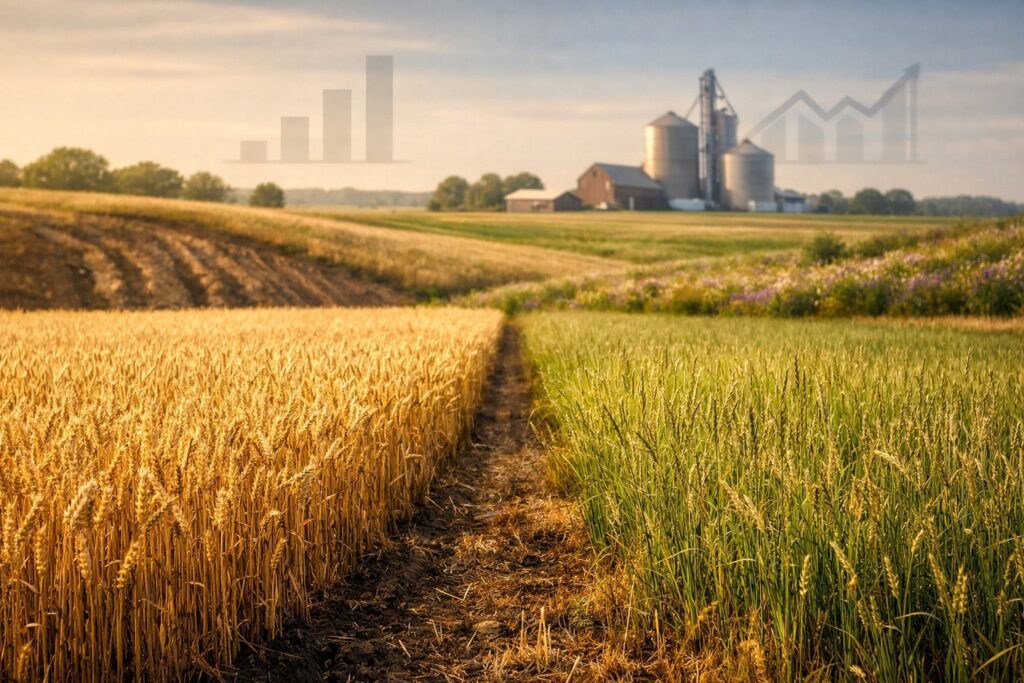
Here, perennial grains still lag. The Land Institute reports that elite experimental lines of perennial wheat currently yield around 50–70% of comparable annual wheat varieties. Field trials of intermediate wheatgrass, the species behind Kernza, show a similar pattern. Grain yields can be respectable in the first two or three years but often peak and decline as plants age, forcing farmers either to accept lower returns or to replant more often than originally hoped.
Recent research on intermediate wheatgrass systems in North America paints a more nuanced picture. In one trial, scientists compared a “grain-plus-forage” system, where stands are grazed or cut for feed as well as harvested for grain, against a grain-only system. The grain-only plots did better in year two, but by year four the dual-use plots produced higher grain yields, while forage peaked in year three across systems.
This suggests that perennial grains may make most economic sense not as pure grain crops, but as multi-purpose plants that can feed livestock, protect soil and deliver grain in the same field.
Still, surveys of farmers in early perennial-grain experiments show the attractions and hard limits. Many organic producers are drawn by the environmental benefits – reduced erosion, improved water quality, more wildlife habitat – but worry about yield penalties, weed control and weak markets. Conventional farmers are even more cautious, with a larger share unconvinced that perennials will reduce soil and nutrient losses enough to justify the risk.
For lenders and crop insurers, that risk is significant. An unproven crop that yields two-thirds as much as wheat, has thin commodity markets and may need to be replanted after four or five years will not pass many credit committees – especially when interest rates are high and margins are tight.
The China rice experiment: proof of concept, not a template
If Kernza is the flagship for temperate grains, perennial rice is the most advanced real-world test of the idea.
Researchers at Yunnan University and partners developed perennial rice by crossing a domesticated Asian rice variety with a wild perennial African relative, then selecting for plants that could regrow after harvest. Large-scale field trials in China, and farmer fields in China and Uganda, have now produced a robust data set.
In irrigated systems, the leading variety, PR23, has delivered on the central promise: eight harvests over four years from a single planting, with average yields of about 6.8 tonnes per hectare per harvest, slightly higher than the 6.7 tonnes achieved by annual rice replanted each season in the same trials.
Because the field is not ploughed and replanted every year, farmers can save significantly on labour, seed, fuel and machinery. Some analyses suggest that perennial rice can cut production input costs by more than 50%, while also reducing soil erosion and greenhouse-gas emissions per unit of grain.
It is not a fairy-tale technology. Yields tend to fall after four years, leading researchers to recommend replanting at that point. Pest and disease dynamics change, sometimes in unexpected ways. Management is different enough that extension services need to catch up.
But the core point is important. Perennial rice shows that, under the right conditions, a perennial grain can match annual yields over multiple seasons, while cutting costs and environmental impacts. That proof of concept matters a great deal for the perennial-grain movement as a whole.
It does not mean that Kernza, perennial wheat or other temperate cereals will quickly reach the same performance. Ecologies, markets and breeding baselines are different. Yet the rice story weakens the argument that perennials are doomed to be low-yielding forever.
Who pays for the transition?
Even if the biology can work, the economics remain brutal.
Globally, agriculture is already heavily subsidised. Various assessments put annual government support to the farm sector at around $600bn a year across major economies, with some recent OECD estimates suggesting support has risen to more than $840bn in 2021–23.
Most of that money does not reward soil protection or innovation. Analyses of subsidy patterns show that the bulk goes to market price support and direct payments tied to production, with only a small fraction directed to conservation or research.
Perennial-grain advocates, including scientists at The Land Institute, argue that this is backwards. As one of the institute’s senior researchers has pointed out, current support effectively props up annual systems that erode soils and destabilise climate, while perennial grains – which could reduce erosion, nutrient losses and emissions – fight for scraps of research funding and a handful of corporate partnerships.
The policy ask is not to abolish annual cereals. It is to redirect a sliver of existing support to de-risk perennial grains for early adopters:
- Paying farmers for verified reductions in erosion, nutrient runoff and greenhouse-gas emissions when they plant perennial grains on vulnerable land;
- Offering multi-year contracts that guarantee a floor price for Kernza and other perennials, recognising their ecosystem services;
- Funding regional processing infrastructure, so that grain grown in one state does not have to travel halfway across a continent to reach a mill.
Without that kind of support, perennial grains are likely to remain a boutique ingredient for premium cereals and craft beers, rather than a meaningful part of the global grain portfolio.
Cracking the supply chain problem
The biology and policy debates can obscure a more mundane hurdle: logistics.
Kernza is not just a new crop. It is a new supply chain. A 2023 review of the Kernza Commercialization and Adoption Programme (KernzaCAP), funded by the USDA, described the effort required to align plant breeding, agronomy, ecosystem-services research, extension work and market development – all for a grain that barely exists on commodity exchanges.
For food companies, the list of questions is familiar:
- Can they secure enough supply at consistent quality?
- Who handles cleaning, de-hulling and milling?
- How do they label a grain most consumers have never heard of?
- Does the sustainability story justify a premium on the shelf – and will retailers make space?
Early experiences suggest mixed answers. Some brands have successfully marketed Kernza as part of regenerative or climate-friendly ranges. Others have found that consumers are more interested in taste and price than in root depth. Businesses involved in the first wave of Kernza products have spoken of the need for a clearer message and tighter coordination between growers, processors and brands if the grain is to move beyond niche status.
The risk is that perennial grains end up stuck in a familiar trap: trapped between research plots too small to interest mainstream processors and markets too immature to justify farmers planting more hectares.
A realistic role by 2035
Given the scale of global agriculture, it is easy either to over-sell or to dismiss perennial grains.
On one hand, proponents sometimes talk in near-revolutionary terms. Perennials, they argue, could underpin a new kind of agriculture that grows food while rebuilding soil, cutting emissions and reducing flood risk. Academic reviews broadly support the environmental potential, though they stress ongoing yield challenges and the need for careful management.
On the other hand, critics point to the numbers: a few thousand acres of perennial grains in a world with more than a billion hectares of annual crops. Even if Kernza plantings doubled every few years, it would take decades to reach a meaningful share of global cereal land.
A more grounded view is to see perennial grains not as a wholesale replacement for annual cereals, but as a new asset class in the agricultural portfolio.
By the mid-2030s, a plausible success scenario might look like this:
- Perennial cereals – Kernza, advanced perennial wheats and perhaps hybrids inspired by the Chinese rice work – are grown on strategic slices of landscape: sloping fields prone to erosion, zones around rivers and lakes, and marginal land where annual yields are already unreliable.
- In those niches, they provide a mix of grain, forage and ecosystem services, backed by contracts from food companies and water utilities that value reduced sediment and nutrient loads downstream.
- Governments adjust a small share of their subsidy budgets to reward verified soil-carbon gains and water-quality improvements from perennial systems.
- For farmers, perennials are no longer an all-or-nothing bet but one of several tools to manage climate and financial risk.
Even that limited shift could be significant. If perennial grains occupied, say, a few million hectares by 2035 – still a rounding error in global statistics – but those hectares were concentrated in fragile watersheds and erosion hotspots, the environmental upside could be disproportionate.
The open questions are practical ones. Can breeders continue to close the yield gap without sacrificing perenniality? Can agronomists fine-tune dual-use systems that deliver enough grain and forage to satisfy farm budgets? Can policymakers and companies structure payments that reflect long-term soil and water benefits, rather than short-term tonnage?
Soil as an economic asset
Perennial grains sit at the intersection of science, policy and finance. They force an uncomfortable question: what, exactly, is soil worth?
Soil scientists have long described soil as effectively non-renewable on human time scales. It can take centuries to rebuild what is lost in a single bad decade of erosion. Yet most economic systems still treat topsoil as an infinite resource and the damage from losing it as someone else’s problem – often a downstream water utility or a fishing community.
Kernza and its perennial cousins do not change that overnight. They are, at this stage, experiments in aligning agronomy with ecology and economics. They come with real trade-offs and no guarantees.
But they also offer a rare thing in climate politics: a concrete, testable alternative. Instead of only asking farmers to fine-tune fertiliser rates or adopt cover crops between annual harvests, perennial grains ask whether some portion of cropland can behave more like a prairie or a wetland while still producing food.
Whether Kernza “wins” in the marketplace may matter less than whether the experiment it represents succeeds. If, a decade from now, a modest but growing share of the world’s grain comes from fields that are never ploughed, whose soils are thickening rather than thinning, it will be because policy, finance and plant science managed to pull in the same direction.
For an agricultural system that often feels trapped on a treadmill of yield, inputs and climate risk, that would be a profound change – even if it starts with just a few scruffy stands of grass in a Kansas field.