
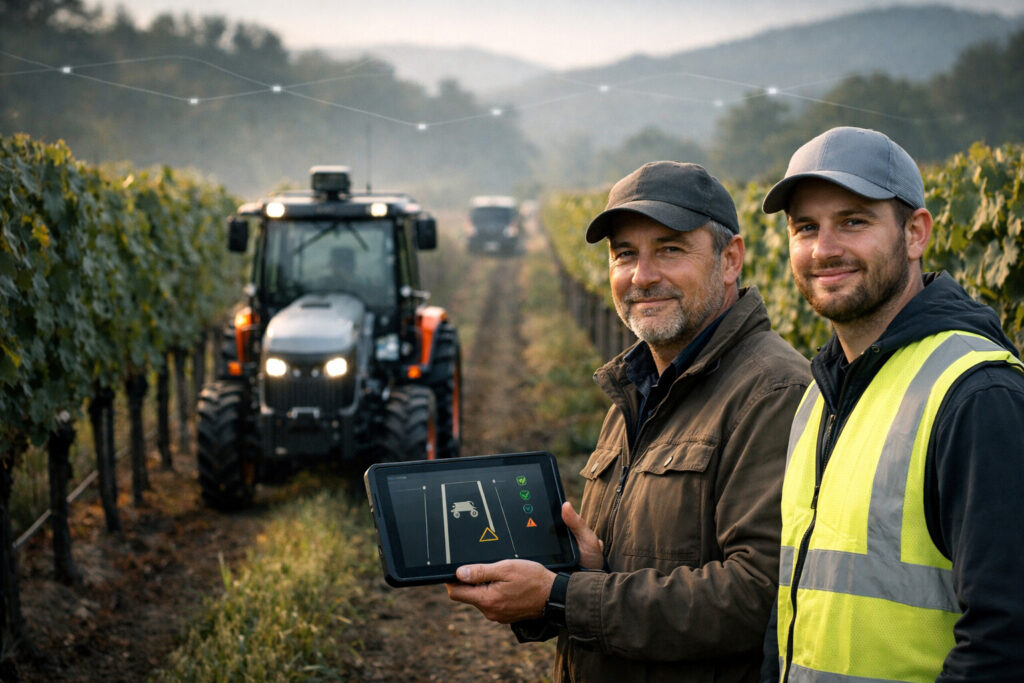
At first glance, it looks like the least futuristic place to talk about “autonomy”: a narrow lane between vineyard rows, where the job is repetitive, dusty, and unforgiving of mistakes. But that is precisely the point.
On January 6, at CES 2026 in Las Vegas, Kubota said it will commercialise a factory-integrated autonomous system for its M5 Narrow specialty tractor — a 105.7-horsepower diesel machine aimed at orchards and vineyards — built in partnership with the autonomy software company Agtonomy.
In the same breath, the Japanese equipment maker showed a concept platform robot called KVPR, a “transformer” machine that can expand and contract, shift its stance, and swap tools — the kind of modular robotics that Silicon Valley likes to promise, but that agriculture rarely gets to buy.
Put together, the two announcements amount to a quiet statement about where autonomy is actually likely to work first — and why the next big leap in farm automation may not start with broad-acre corn and soybeans, but with the high-value crops that are most exposed to labour scarcity.
The economics that make vineyards interesting
Specialty crops — fruits, vegetables, tree nuts and nursery products — are not a sideshow in US agriculture. The American Farm Bureau estimates they account for roughly one-fifth of US agricultural cash receipts across about 220,000 farms, spread across more than 350 commodities.
They are also disproportionately dependent on human hands. USDA analysis has found that farms specialising in specialty crops have the highest labour costs across farm types, with labour accounting for almost 40% of total cash expenses (including hired and contract labour and benefits).
That “almost 40%” is not a rounding error. The Farm Bureau, using USDA survey data, puts numbers to the squeeze: in 2023, specialty crop farms averaged more than $466,000 per farm in cash expenses, with labour averaging $193,250 — up 60% from 2021.
Add wage pressure and the story sharpens. USDA’s Farm Labor report shows farm operators paid hired workers an average gross wage of $19.52 per hour during the April 2025 reference week; field workers averaged $18.58.
Then there is the structural reliance on seasonal immigration programmes. The US Department of Labor’s OFLC data show 398,258 H-2A positions certified in FY 2025. Whether the political climate is permissive or restrictive, the administrative burden and uncertainty around seasonal labour remain real operating risks for growers.
For equipment makers, all of this adds up to a simple proposition: if autonomy is going to pay for itself anywhere, it is most likely to do so where labour is both expensive and hard to replace — and where the crop value can justify high fixed costs.
Why Kubota is starting with “routine passes”
Kubota’s announcement is careful in what it claims. This is not a sci-fi robot that does everything on a farm. The company described a “smart, integrated autonomous solution” built into the M5 Narrow tractor, using sensing and AI, developed with Agtonomy, for the specialty crop market.
The emphasis is on tasks such as mowing and spraying — the work that happens again and again, row after row, where consistency matters and the labour is hard to staff. Kubota and Agtonomy have positioned the collaboration as a way to commercialise autonomous operations on Kubota’s diesel tractors for these use cases.
That choice is pragmatic. In orchards and vineyards, geometry is constrained: rows are known, paths are repeated, and many operations are variations on the same pass. That makes autonomy easier to validate — and safer to deploy — than open-ended tasks where terrain, traffic, or crop conditions shift unpredictably.
It also targets work that is not just labour-intensive but physically unpleasant. Spraying can expose workers to chemicals; mowing and under-vine work is monotonous and time-sensitive. If autonomy can absorb the least attractive shifts, growers can redeploy scarce skilled staff to supervision, maintenance, and the judgement-heavy work machines still struggle with.
Kubota has also sought real-world validation. Coverage of the CES demonstration described field testing with Treasury Wine Estates, with one manager noting the system handles “routine passes… across every row and block”. It is not a peer-reviewed trial, but it is a telling choice of reference: vineyards are where labour costs hurt, and where small mistakes can become expensive.
Factory-integrated autonomy is a strategic move
A key detail in the CES messaging is that the autonomy is built in, not bolted on.
Agriculture is full of retrofits, and there is a reason: fleets last decades. But retrofits bring friction — separate warranties, finger-pointing between OEMs and tech providers, and a servicing experience that can collapse in the field at peak season.
Kubota’s pitch is the opposite: “fully built into” the tractor, framed as reliability and adoption, not experimentation. If you are a grower whose margins are already squeezed by labour and input costs, the last thing you want is autonomy that only works when a specialist is onsite.
This is where the dealer channel matters. An earlier industry report on the Kubota–Agtonomy effort described work to prepare Kubota dealers for autonomous equipment, recognising that autonomy is not just a product — it is a support model that demands training, diagnostics, and new service habits.
In other words: autonomy will not scale simply because a tractor can drive itself. It scales when the system can be maintained, updated, and trusted by the same local network that already keeps farms running.
Autonomy is moving from “big acres” to “high value”
Kubota is hardly the first to bring autonomous farming equipment to CES. John Deere used CES 2022 to unveil a fully autonomous 8R tractor that it said was ready for large-scale production.
But the competitive landscape has been shifting in a useful way: away from the idea that autonomy is a single, monolithic breakthrough, and toward a portfolio of focused applications.
Deere, for example, has spoken about extending autonomy into more machine types and environments — including orchard-oriented use cases — alongside broad-acre work. AGCO and PTx Trimble have leaned into a mixed approach that includes retrofit autonomy systems and a longer-term ambition to cover more of the crop cycle with autonomous tools.
Kubota’s distinctive angle is its brand DNA. It is not the “largest machine on the prairie” company. It is a compact equipment specialist with deep penetration in the smaller tractors that dominate many orchard and vineyard operations. Starting autonomy there is not a detour; it is a home-field advantage.
The “KVPR” robot is a clue, not a product
If the M5 Narrow autonomy announcement is about commercial reality, the KVPR concept is about direction.
Kubota described KVPR as a versatile platform robot that can expand, contract, and move along multiple axes — with interchangeable attachments — designed to serve different tasks and seasons with one base platform. Industry coverage highlighted lateral and diagonal movement, and automatic attachment changes — the sort of manoeuvrability that matters in tight farm layouts and in adjacent markets like construction and civil engineering.
Notably, Kubota has not published the most basic details that would let a grower evaluate KVPR as a machine: powertrain, runtime, payload, price, or timeline. That is typical for a concept — and it is why KVPR should be read less as “the next tractor” and more as a statement about modularity.
The agricultural equipment industry has long sold farms specialised machines for specialised moments: one for mowing, one for spraying, one for handling materials, another for bed work — each sitting idle for long stretches. A platform robot is a bet that the economics can flip: one base, multiple toolheads, higher utilisation.
Whether that ever pencils out is uncertain. But the mere fact Kubota chose to pair a near-term commercial autonomy announcement with a modular robot concept suggests it sees a long runway: first embed autonomy into familiar machines; then, once operators trust autonomous work, introduce machines designed around autonomy from the start.
The hard problems are not the ones on stage
CES is good at spectacle. Agriculture is good at exposing what breaks under pressure.
If Kubota’s autonomy push succeeds, it will be because it solved a set of unglamorous problems:
Safety and liability. In an orchard, humans, vehicles, and animals can appear suddenly. Autonomy needs not just navigation, but robust obstacle detection and clear responsibility when something goes wrong. Kubota has framed its approach as “human-centric” and about customer choice — whether the operator is in the seat or managing via an app. But choice also implies complexity: switching between modes must be foolproof.
Connectivity and operational discipline. Remote supervision can reduce labour needs — but only if farms have reliable connectivity and trained staff who treat autonomy as an operational system, not a gadget.
Service and uptime. A grower will forgive a flashy concept that never ships. They will not forgive autonomy that fails during a narrow spraying window. That is why factory integration and dealer readiness may matter as much as the autonomy stack itself.
Affordability and farm structure. Autonomy tends to replace variable labour costs with fixed capital costs. That can widen the gap between larger operators who can finance expensive equipment and smaller growers who cannot. The industry rarely talks about this at launch events. It becomes unavoidable two seasons later.
What Kubota is really selling: time and optionality
Kubota’s CES story is built around big societal themes — labour shortages and an ageing producer base — that are easy to nod along to.
But in the field, the product will be judged on smaller things: whether it reduces rework, whether it keeps a farm on schedule, whether it lowers exposure to unpleasant tasks, and whether it gives managers the one resource they cannot buy in bulk during a crunch — time.
It is also a bet on optionality. A tractor that can be driven conventionally, or run autonomously for specific repetitive passes, fits the way farms adopt technology: cautiously, season by season, task by task. That is less glamorous than a “lights-out farm”. It is also more believable.
If autonomy is going to become normal in agriculture, it will probably arrive the same way many farm innovations do: first as a tool for the most painful labour bottlenecks, then as a platform for new ways of working. Kubota’s narrow tractor, aimed at vineyards and orchards, is a reminder that the road to the future often starts in the tightest rows.