Upside Robotics says its small autonomous machines can cut corn nitrogen use by as much as 70% — and save growers about $150 an acre. The bigger question is whether micro-dosing can scale across the brutal maths of row-crop farming.
In a North American corn field, the hardest problem is rarely the science. It is timing.
Corn does not “eat” nitrogen in one sitting. The crop’s demand rises as the season progresses — yet much of the fertiliser still gets applied early, because that is when machinery and labour can get in, and because weather windows close fast. The result is a familiar mismatch: farmers pay up front, and a meaningful share of nitrogen does not end up in the plant.
One recent review of the research literature puts the blunt version of this at roughly half: around 50% of applied nitrogen fertiliser can remain unused by crops, escaping via leaching, runoff, volatilisation or other pathways.
This is not a niche issue. The US planted 95.2mn acres of corn in 2025, according to USDA’s National Agricultural Statistics Service. Corn remains the anchor crop in American agriculture — and a heavy user of nitrogen. University of Illinois researchers estimate trend nitrogen application rates for corn at 151.8 pounds per acre in 2024, up from the early 2000s, even as efficiency has improved.
Now layer on the second bill: the environmental one. The US Environmental Protection Agency’s latest National Rivers and Streams Assessment finds 44% of river and stream miles in poor condition for nitrogen and 42% in poor condition for phosphorus, calling nutrients the most widespread stressors. And the climate ledger is not forgiving either: the IPCC’s default guidance for inventories uses a rule of thumb that about 1% of nitrogen added to managed soils is emitted as nitrous oxide (N₂O) — a potent greenhouse gas.
Into this mess of agronomy, economics and regulation steps a small, solar-powered robot from Waterloo, Ontario.
Upside Robotics, founded in 2024, is betting that the real breakthrough in fertiliser efficiency will not come from a new chemical, but from a new schedule. Instead of a few large applications, it wants to deliver many small “right-sized” doses to the root zone, adjusting timing and quantity using soil, weather and crop-stage data.
It is an old idea — split applications are standard advice in many systems — made awkward by labour constraints, narrow field windows, and the sheer scale of modern operations. Upside’s pitch is that autonomy can make the agronomy practical.
Why timing beats “rate” in the fertiliser debate
Precision agriculture has spent decades improving where inputs go. Variable-rate application, better guidance, better maps and better sensors have helped farmers become more targeted. But when nitrogen is applied still often looks like a compromise between biology and logistics.
That compromise is costly. Fertiliser is not just another line item. In an analysis of US cost data, farmdoc daily notes fertiliser costs represented about 45% of total direct costs for corn over 2000–2024. When prices spike, the pressure to squeeze efficiency rises sharply — and so does farmers’ tolerance for tools that have a clear payback.
This is where “micro-dosing” becomes interesting. It reframes nitrogen not as a one-time purchase, but as a managed service: delivered in smaller increments, closer to the moment of demand. The promise is not simply lower use, but lower waste — and therefore less money that ends up in groundwater, rivers, or the atmosphere.
A robot designed to fit between the rows — and into a budget
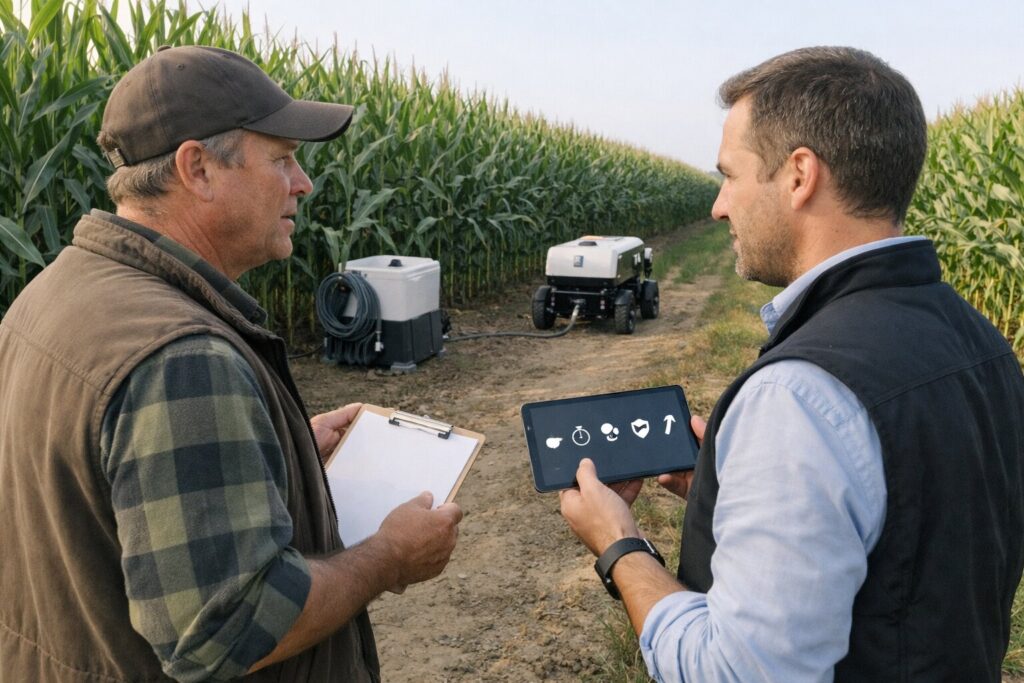
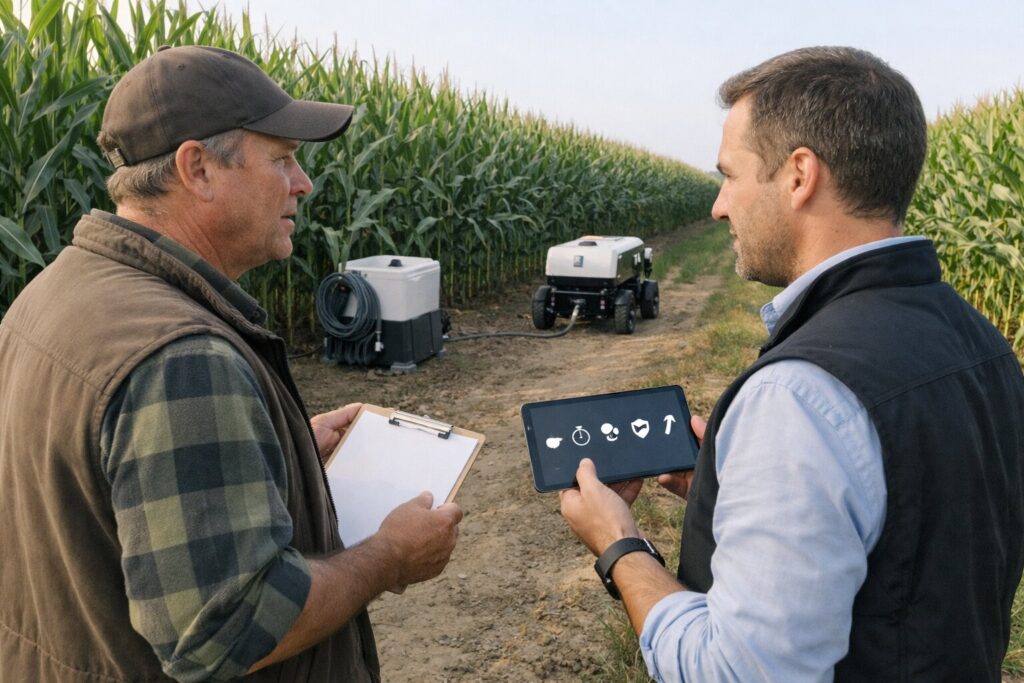
Upside’s machines are deliberately small. On its website, the company describes a 150-pound robot meant to reduce soil compaction and run continuously with a 10-hour battery life and a 60-minute full recharge. It says each unit covers about 1 acre per hour, “ideal for managing up to 100 acres per week”, and carries a 50L (13-gallon) tank that can refill at a base station.
Those numbers matter because row-crop economics are unforgiving. A fancy machine that works beautifully but cannot cover enough acres during the season is a science project. One that can cover acres cheaply becomes infrastructure.
Upside’s early traction suggests it has found at least one wedge. In a TechCrunch interview published February 11, the company said it scaled from 70 acres in 2024 to 1,200 acres in 2025, and is aiming to serve more than 3,000 acres in 2026, with 100% customer retention since launch. It also claimed that it has helped customers cut fertiliser use by 70%, equating to about $150 in savings per acre per season, and that more than 200 farms are on a waitlist.
A University of Waterloo release, published February 12, adds more operational colour: it says Upside’s robots have driven more than 10,000 autonomous kilometres and applied over 100,000 litres of fertiliser across more than 1,300 acres.
The company has also raised capital to push this next phase. TechCrunch reported a $7.5mn seed round led by Plural, with participation from Garage Capital and founders of Clearpath Robotics. The University of Waterloo described the same round and said it brings total funding to more than $11mn.
The adoption test: can autonomy survive the realities of corn?
A robot that can move down a row is not the same as a system that can survive a season.
Corn fields are messy places: ruts, residue, weeds, variable row spacing, unexpected weather, narrow windows, and the simple fact that farms do not stop because a sensor needs cleaning. Autonomy only matters if it reduces hassle, not if it creates a new kind of work.
That is the quiet appeal of Upside’s approach: it is not asking farmers to “believe in robots”. It is asking them to believe in a spreadsheet.
Take the company’s own headline claim — roughly $150 per acre in savings. That number is big enough to get attention in a business where margins can be thin and volatile, and where fertiliser already represents a large share of direct costs.
But it also invites hard questions:
- Savings relative to what baseline? A 70% cut is dramatic; it implies either high starting rates, unusually large inefficiencies, or a very targeted subset of applications being replaced. The agronomy will vary by soil type, weather, hybrid, and management. Even farm-level best practice differs widely.
- Yield risk is the hidden tax. Farmers will trade a lot for lower costs — except yield. “Maintaining performance” is the phrase the company uses, and it is the right one. In corn, a small yield penalty can wipe out input savings.
- Coverage is destiny. At about an acre an hour, a single unit’s reach is finite. The business model has to make sense when a farm needs multiple robots, base stations, service support, and redundancy.
This is why the company’s “waitlist” claim matters as much as its technology. In robotics, demand is often easy to claim and hard to prove. If farms are returning season after season — as Upside says they are — that is a stronger signal than a slick demo.
Why this matters beyond one startup
Upside is not the first company to promise “apply what the crop needs, when it needs it.” The novelty is the attempt to make that promise operationally cheap.
If it works, the implications reach beyond corn.
First, it strengthens a theme that keeps showing up in AgTech after a decade of hype: the winning product is the one that changes farmers’ cost structure, not the one that produces the prettiest map.
Second, it points to a shift in how we think about input efficiency. The last era of precision agriculture was largely about information: better data, better decisions. The next era may be about execution: machines that can actually carry out those decisions at the right moment, repeatedly, without burning labour.
Third, it offers a more practical bridge between farm economics and public policy. Regulators and water managers have long struggled with nutrient pollution because it is diffuse — hard to measure, hard to enforce, and politically sensitive. Tools that reduce nitrogen losses while keeping farms profitable are rare. If robotics can deliver that outcome without adding complexity, it becomes less about “green compliance” and more about rational management.
The irony is that the technology’s most important contribution may be psychological. By turning nitrogen into something that can be managed continuously — like irrigation in a drip system rather than flood irrigation — it makes waste feel less like a necessary evil and more like a fixable leak.
On a farm, that is often the difference between a nice idea and a tool that gets used.