
The latest funding round is not just a story about cow collars or virtual fencing. It is a story about whether one of agriculture’s oldest industries is finally ready to treat software as core infrastructure.
A funding round that means more than valuation
It is tempting to look at Halter’s latest fundraise and reduce it to a clever headline: invisible fences, solar-powered collars, and a $2 billion valuation. But that would miss what is actually happening. On March 24, Halter said it had raised $220 million in Series E funding at a $2 billion valuation, less than a year after a June 2025 round that valued the company at $1 billion. More importantly, this is no longer a small pilot story. Halter says it now serves more than 2,000 ranchers and farmers across New Zealand, Australia, and the U.S., has sold one million collars, and has helped American ranchers build 60,000 miles of virtual fencing since launching in the U.S. in 2024.
Why this round stands out in a harder market
That scale matters because the funding environment is no longer especially forgiving. According to AgFunder’s latest report, global agrifoodtech funding totaled $16.2 billion in 2025, down 3% year over year, with investors becoming more selective and favoring businesses with tangible science, clearer unit economics, and more visible paths to revenue. In other words, this is not a spray-and-pray market. A round this large suggests investors believe virtual fencing is moving out of the category of “interesting agtech” and into something closer to operational infrastructure.
The backdrop: a cattle industry under pressure
The timing is also revealing. U.S. cattle country is under real strain. USDA says there were 86.2 million head of cattle and calves on U.S. farms as of January 1, 2026, with 27.6 million beef cows, down 1% from a year earlier. The American Farm Bureau Federation says that puts the national cattle inventory at a 75-year low, with the 2025 calf crop also at a record low. USDA’s 2025 beef-industry white paper adds another layer of pressure: since 2017, the U.S. has lost more than 17% of cattle ranches, or over 150,000 operations. And while some input categories have eased, cash labor expenses across U.S. agriculture are still projected to rise to $53.9 billion in 2026. The ranching problem, in other words, is not a lack of data. It is a shortage of labor leverage, operating flexibility, and margin for error.
What virtual fencing actually changes
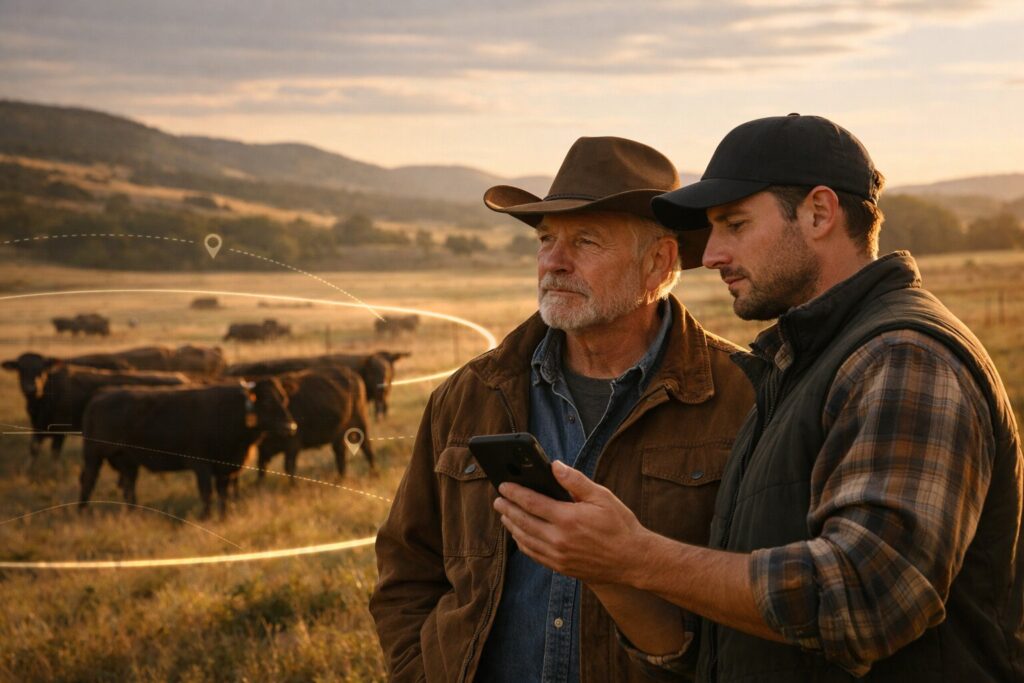
That is precisely where virtual fencing becomes more than a gadget. Halter’s system combines collars, connectivity infrastructure, and software so ranchers can draw and redraw grazing boundaries from a phone, move cattle without breaking ground or stringing wire, and monitor the herd continuously. When Halter raised its Series D in June 2025, Reuters reported it was already working with about 150 ranchers in 18 U.S. states. Nine months later, the company says American users have built 60,000 miles of virtual fencing. That is not proof that the model works everywhere. But it is strong evidence that ranchers are willing to use software when it removes a stubborn physical bottleneck.
No longer experimental technology
The underlying technology is also far more mature than many outsiders probably assume. North Dakota State University’s extension service says virtual fencing can be as effective as electrical fencing once livestock are trained, with effectiveness ranging from 80% to 99% depending on the system and grazing strategy. An NDSU research report found 92% containment in designated grazing areas in both rangeland and annual forage systems. A recent peer-reviewed review likewise found that cattle generally learn the audio cue quickly, often achieving containment rates above 90% within days. That does not make the technology perfect, but it does put it well beyond the phase of being merely experimental.
Why the appeal goes beyond labor savings
Just as important, the value proposition is broader than labor reduction alone. USDA Climate Hubs says virtual fencing can help ranchers create wildfire fuel breaks, exclude cattle from management-sensitive areas, reduce overgrazing, improve soil and water outcomes through managed grazing, and avoid some wildlife conflicts associated with physical wire fencing. The U.S. Fish and Wildlife Service is already funding a Nevada project specifically designed to test whether virtual fencing can support livestock production and wildlife habitat at the same time. Conservation groups are interested for the same reason ranchers are: the technology offers flexibility. It can move cattle toward desired forage, away from riparian zones, or out of conflict-prone areas without the hard permanence of conventional fencing.
The limitations are real too
But this is where the story gets more interesting, because virtual fencing is not frictionless software in the Silicon Valley sense. University of Nevada, Reno research notes that a base station can cost roughly $10,000, with service fees around $60 per animal per year, and that dense tree cover and rough topography can limit real-time monitoring and fence changes. USDA’s NRCS also flags high upfront costs and dependence on reliable technology as real drawbacks. On animal welfare, the literature is encouraging but not spotless: recent review work found generally limited welfare impacts compared with traditional fencing, but also reported occasional collar abrasions and some short-term behavioral disruption. So yes, virtual fencing can work. But it is not plug-and-play magic.
The economics of adoption across a fragmented industry
The economics get even harder when you remember how fragmented the beef industry remains. USDA’s ERS says the average U.S. beef farm had about 47 cows in 2022, and 622,000 farms had beef cows at all. That matters because a technology can look compelling on very large Western ranches and still struggle if its pricing and service model do not translate across a very uneven industry. The academic literature on virtual fencing makes the same point more formally: producers see potential, but they also have reservations about cost, and the economics do not map neatly onto the old logic of physical fencing. The winners in this market will not be the companies with the flashiest demos. They will be the ones that can show durable ROI across very different ranch sizes, geographies, and management styles.
From fence replacement to ranch operating system
That is why Halter’s latest round should be read less as a “cow collar” story than as a much larger platform bet. The company says the new capital will fund expansion across existing markets, move into Ireland and the U.K. later this year, and deepen product development in animal health monitoring and pasture management. That is a much bigger ambition than replacing fence posts. It is an attempt to turn the fence into the wedge product for a broader operating system for livestock operations. The collar, in that reading, is just the first interface.
The bigger lesson for AgTech
The bigger lesson for agtech is straightforward. Farmers and ranchers do not adopt technology because it feels futuristic. They adopt it when it takes real cost, labor, or uncertainty out of the business. In a market where investors now say they want real economics instead of abstract growth stories, Halter’s $220 million raise looks less like hype and more like a test case. The real question is no longer whether virtual fencing can work. It is whether enough ranchers conclude that software is now as essential to running a cattle operation as wire once was.