BASF’s acquisition of AgBiTech and the emergence of targeted protein degradation suggest the crop-protection industry is finally moving past a stale binary. The next chapter is likely to be less about choosing between chemistry and biology, and more about building deeper, more resilient toolkits for farmers.
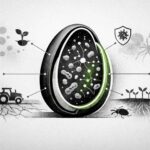
On March 31, BASF completed its acquisition of AgBiTech, taking full ownership of a biological insect-control company built around naturally occurring viruses that target caterpillar pests. Within the same stretch of news flow, UK startup Bindbridge was making the case that targeted protein degradation, powered by AI-designed molecular glues, could open a new class of herbicides, fungicides, and insecticides. Those are very different technologies. But together they point to the same conclusion: crop protection is entering a broader search for new mechanisms, new combinations, and new ways to stay ahead of resistance.
For years, the future of crop protection was often framed as a simple contest between conventional chemistry and greener biological alternatives. That framing now looks too narrow. BASF is buying biological capacity. Bayer is advancing icafolin-methyl, which it describes as the first new mode of action for post-emergent weed control in broadacre crops in more than 30 years. Startups such as Bindbridge are trying to create still newer mechanisms by borrowing ideas from drug discovery. The industry’s real shift is not ideological. It is practical. The old toolbox is under pressure, and the new one will almost certainly have to be more diverse.
Resistance has stopped being a side story
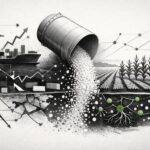
Start with the scale of dependence. According to FAO, agriculture used 3.73 million tonnes of pesticide active ingredients in 2023. That was down slightly from 2022, but still 14% higher than a decade earlier and roughly double the level of 1990. Pesticide use intensity reached 2.40 kilograms per hectare of cropland, and herbicides accounted for the largest share of use globally. This is not a sector inching away from chemical crop protection. It is a sector still deeply dependent on it.
That dependence would be less alarming if efficacy were standing still. It is not. The International Herbicide-Resistant Weed Database now lists 541 unique cases of herbicide-resistant weeds worldwide, spanning 273 species. Resistance has been documented against 168 herbicides, across 102 crops in 75 countries, and weeds have evolved resistance to 21 of the 31 known herbicide sites of action. Those are not edge-case numbers. They are a reminder that resistance is no longer a localized agronomy problem. It is a structural constraint on the whole crop-protection model.
That is why even incremental breakthroughs suddenly matter more. When Bayer submitted registration applications for icafolin-methyl in major markets last year, it described the product as agriculture’s first new mode of action for post-emergent weed control in broadacre crops in over 30 years, with a first launch expected from 2028 and initial availability in Brazil. Whether icafolin lives up to its commercial promise is still to be seen. But the fact that such a development stands out so sharply tells you how long the industry has been living off variations on older chemistry.
Why BASF bought AgBiTech now
Seen in that context, BASF’s AgBiTech deal looks less like a niche biologicals acquisition and more like a portfolio hedge against a harder crop-protection future. AgBiTech, founded in 2000 and headquartered in Fort Worth, Texas, has built a business around nucleopolyhedrovirus, or NPV, technology. It operates in Brazil, the United States, and Australia, and serves growers in crops including soybean, corn, cotton, and specialty crops. BASF is not just buying products. It is buying intellectual property, manufacturing operations, research facilities, and people. For a company that invested €919 million in agricultural R&D in 2024, that is a sign that capability-building matters as much as product inventory.
The technology itself helps explain the attraction. AgBiTech’s products are based on naturally occurring viruses that control key caterpillar pests, and the company says its baculovirus insecticides can control pests that are becoming resistant to chemical insecticides. Reviews of baculoviruses describe them as highly host-specific and environmentally compatible, traits that make them especially well suited to integrated pest management rather than broad-spectrum overuse. In other words, their value is not that they replace everything. Their value is that they add precision where conventional chemistry is losing edge.
That specificity, of course, is also the catch. Viral biopesticides remain a relatively small part of the overall pesticide market in part because narrow host range and slower action can limit where they fit. Farmers still need products that work reliably under heavy field pressure, fit into tight spray windows, and justify their cost acre by acre. That is exactly why BASF’s move matters. It suggests the company is not imagining a clean replacement story where biology simply displaces chemistry. It is building a more layered offering in which biological tools can sit beside chemical treatments inside integrated pest-management programs. BASF says as much in its own description of BioSolutions, which it frames as complementing chemical treatments, including for resistance management.
Why the new chemistry story is back on the table
If BASF’s acquisition represents one side of the crop-protection reset, Bindbridge represents another. The startup raised $3.8 million in March and says the money will help it pursue co-development projects with larger agrochemical companies while beginning lab testing of its first products. Its platform uses AI to discover and design “molecular glues” that induce targeted protein degradation in plants or pests, with the goal of producing crop-protection agents with novel modes of action.
The appeal of that approach is easy to see. Traditional crop-protection products typically work by inhibiting a target protein or pathway. Targeted protein degradation aims to do something more forceful: remove the protein altogether by exploiting the cell’s own recycling machinery. In both startup and academic framing, that opens the door to proteins that were previously hard or impossible to hit with classical inhibitors. It also introduces a catalytic mechanism, meaning one molecule can potentially trigger the degradation of multiple target proteins rather than acting in a one-to-one fashion. That is why the idea keeps resurfacing whenever the industry starts asking how to move beyond a narrow list of familiar targets.
Importantly, this is no longer just a speculative metaphor borrowed from pharma. A 2025 Communications Biology paper demonstrated targeted protein degradation in the fall armyworm, reporting degradation of one target protein by more than 80% in cells and more than 60% in larvae. The paper positioned the work as a proof of concept for agricultural applications and argued that pesticide resistance, environmental constraints, and the slow flow of new active ingredients are creating an urgent need for new modalities. That does not make targeted protein degradation commercially ready. But it does move the conversation beyond slide-deck futurism.
Still, this part of the story needs restraint. Bindbridge is only now moving toward early lab testing, and the most exciting claims remain prospective. The company argues targeted degradation could one day reduce application rates dramatically, potentially by as much as 100-fold, because molecular glues can act catalytically. That is a striking claim, but it is still a claim. Field stability, formulation, selectivity, regulatory pathways, manufacturing economics, and real-world efficacy under commercial farming conditions all remain open questions. In crop protection, many elegant mechanisms fail not because the biology is wrong, but because the field is unforgiving.
The future is not biological versus chemical
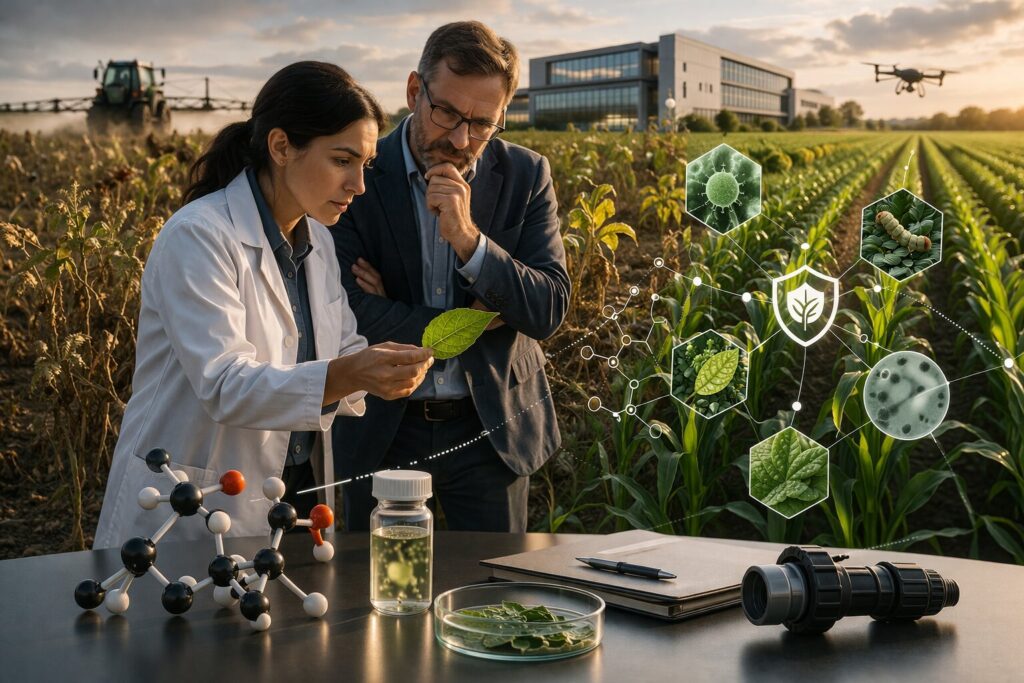
What BASF, Bayer, and startups like Bindbridge collectively suggest is that the most useful frame for the next decade is not substitution but stacking. BASF is expanding into baculovirus-based insect control. Bayer is pursuing a new synthetic herbicide mode of action. Bindbridge is trying to create a computational pipeline for a different class of degraders altogether. These are not mutually exclusive bets. They are signs of an industry rebuilding optionality after a long period in which too much value rested on too few modes of action.
That matters because growers do not buy ideology. They buy performance, reliability, flexibility, and economics. A product that is more sustainable but inconsistent under pressure will struggle. A product that works brilliantly but accelerates resistance will also struggle. The market is moving toward systems that combine different strengths: biological selectivity, chemical durability, resistance-management logic, and increasingly data-driven discovery. BASF’s own messaging around AgBiTech and BioSolutions leans in that direction, as does AgBiTech’s emphasis on tank-mix compatibility and fit within regenerative systems.
That is also why the post-glyphosate era, whenever it fully arrives, is unlikely to be defined by a single successor molecule. It is more likely to be defined by layered toolboxes: older chemistries used more carefully, newer chemistries used more selectively, biologicals used where precision matters, and discovery platforms that widen the target universe. The winners may not be the companies with the loudest sustainability narrative. They may be the ones that can give farmers more credible combinations.
What to watch next
The next clues will come from capital allocation and market sequence. BASF has signaled that Brazil is a particularly important geography, describing it as one of the fastest-growing markets for biological crop protection and highlighting AgBiTech’s strong footprint there. Bayer also expects Brazil to be the first launch market for icafolin. That is not accidental. Brazil is large enough, agronomically intense enough, and commercially important enough to function as both proving ground and prize. If new crop-protection architectures work there, they become much more credible everywhere else.
The other thing to watch is whether the biggest companies keep buying proven biological platforms while smaller science startups increasingly position themselves as discovery partners rather than standalone go-to-market players. That split would make sense. Biologicals often require manufacturing, registrations, distribution, and grower trust. Frontier chemistry and computational discovery, by contrast, can create value much earlier in the pipeline through partnerships and licensing. BASF’s acquisition of a scaled biological platform and Bindbridge’s stated interest in co-development point in exactly that direction.
The deeper point is that crop protection is starting to behave like an industry that knows the easy era is over. Resistance is spreading. Regulatory pressure is not disappearing. Farmers still need yield protection. And the old idea that one blockbuster active ingredient can dominate for decades looks less convincing than it once did. The next race, then, is not simply to make crop protection greener. It is to make it broader, smarter, and harder for pests and weeds to outmaneuver. BASF’s AgBiTech deal and the new wave of targeted-protein-degradation science are early signs that this reset is already underway.