Behind every “natural” pest-control story sits an industrial supply chain. Koppert’s new 3,500 m² climate-controlled flour-moth facility — built with greenhouse specialist Certhon — is a reminder that the future of biological crop protection may depend as much on engineering discipline as ecology.
biocontrol, biological control, integrated pest management, IPM, insect farming, macrobials, beneficial insects, moth eggs, greenhouse agriculture, controlled environment agriculture, climate control, agtech supply chain, Netherlands, sustainable crop protectionWalk into almost any modern greenhouse and you will hear the same pitch: fewer sprays, more biology. Predatory bugs and mites patrol tomato leaves. Parasitic wasps hunt whitefly. Bumblebees do the pollination work that used to be done by hand.
It is a comforting story — nature restoring balance.
But behind this “nature” narrative is an uncomfortable truth that the industry rarely celebrates: biological control increasingly behaves like manufacturing. The constraints are not only biological. They are physical. They are logistical. They are about energy, airflow, temperature stability, and the ability to deliver living products on time, every week, at scale.
That is why a recent investment by Koppert, one of the best-known names in biocontrol, is worth paying attention to. The company is building a large-scale, fully climate-controlled breeding facility for flour moths (Ephestia) in Berkel en Rodenrijs, near Rotterdam — a 3,500 m² hall (about 38,000 sq ft) designed to industrialise a small but crucial step in the biological supply chain.
At first glance, breeding moths can sound like the opposite of crop protection. Most growers spend their lives trying to keep moths out. Yet in controlled environments, certain moth species are not pests but inputs — a kind of feedstock for other beneficial organisms. Koppert calls the project “a world first” at this scale in biological insect production.
Why breed moths at all?
The flour moth is useful not because it is released into crops, but because its eggs are a workhorse ingredient across insect-rearing systems.
In academic literature on mass rearing, the eggs of Ephestia kuehniella are routinely described as “factitious host” material — stand-in eggs used to rear parasitoids such as Trichogramma, one of the world’s most widely deployed biological control agents. Researchers also note why Ephestia became popular in these systems: a favourable egg size, high output from rearing media, and relative ease of mechanisation and sanitation.
Commercially, the same eggs also function as supplementary nutrition in greenhouses, helping beneficial predators establish before pests arrive. Koppert itself sells Entofood (containing Ephestia kuehniella eggs) as an “alternative food” to build and maintain populations of Macrolophus pygmaeus in tomatoes.
Put simply: if you want more beneficial insects in more greenhouses — reliably, year-round — you need more of what those beneficial insects eat (or what is used to produce them). The humble moth becomes a bottleneck.
Biocontrol is growing up — and getting bigger
This industrial logic is showing up across the market.
In Europe, the biocontrol industry body IBMA puts the regional biocontrol market at €1.6bn, roughly 10% of the European crop protection market — large enough to demand supply-chain thinking rather than artisanal production.
Global market sizing varies by definition (some analysts include microbials and biostimulants, others focus on macrobials), but even narrower estimates describe a multi-billion-dollar industry with steady growth. Mordor Intelligence, for example, values the biological control market at $4.01bn in 2025, forecasting $4.29bn in 2026 and $5.98bn by 2031.
Growth, however, changes the nature of the work. In small volumes, it is possible to absorb variability. At industrial scale, variability becomes expensive.
A greenhouse manager can adapt when a shipment of beneficial insects is a day late. A retailer’s supply chain cannot. The bigger the biological share of crop protection becomes, the more it is judged by the standards of chemistry: consistency, shelf life, predictable performance, and dependable delivery.
A “living system” needs a control system
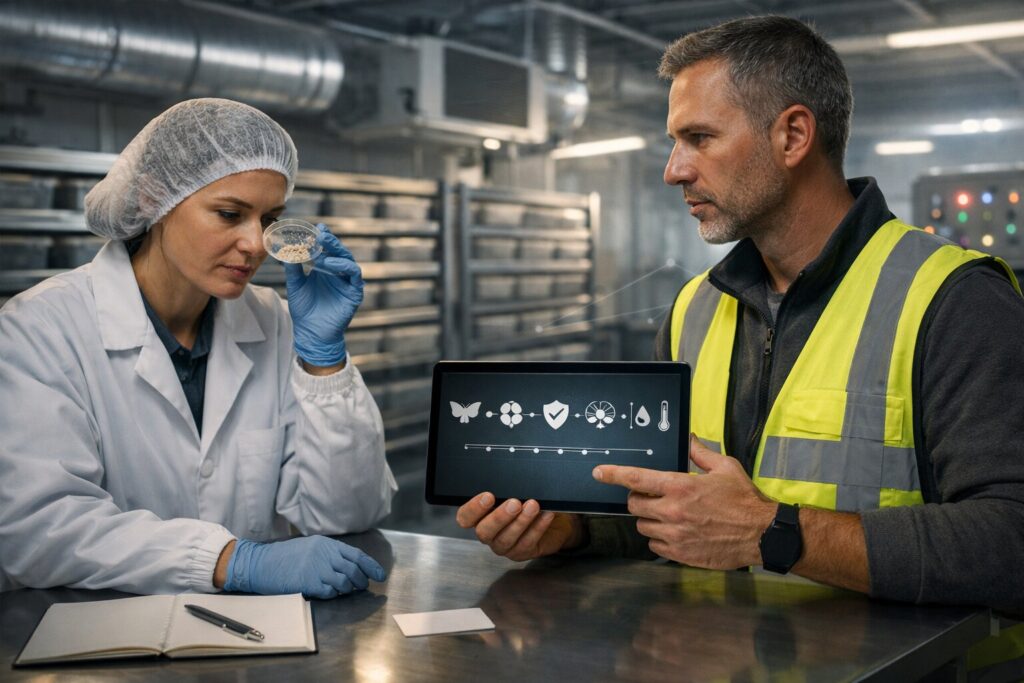
Koppert’s facility is being built with Certhon, a Dutch company better known for high-tech greenhouse projects than insect rearing. Certhon will design and deliver the full climate installation, including air handling units, cooling systems, and its Certhon Control System (CCS).
The most revealing part is not the equipment list, but the philosophy behind it. Certhon describes the installation as something closer to responsive infrastructure than static HVAC — a system that “continuously adjusts the climate to the biology of the flour moths”, aiming to create stability with “minimal energy consumption”.
Koppert, for its part, frames the project as a step-change in operational discipline. “This is our first production facility of this scale and complexity,” said Bram Klein, a project leader at the company. The point is not just to build more capacity, but to create a “more stable and efficient production process”.
This is a subtle but important shift in the language of biocontrol. The industry has spent decades persuading growers that biology can replace sprays. Now it must persuade them that biology can be supplied with industrial reliability.
What makes insect rearing hard at scale
Insect production sits in an awkward middle ground between agriculture and manufacturing. Like agriculture, it deals with living organisms and the inevitable messiness that comes with them: variable life cycles, sensitivity to microclimates, and sudden collapses if conditions drift outside a narrow band.
But unlike agriculture, insect rearing is expected to produce a standardised input on a schedule. A beneficial insect is often shipped as eggs, larvae, pupae, or adults. The “right” stage depends on timing. Shipping windows matter. Cold-chain management matters. And for some systems, upstream inputs — such as moth eggs — become a production multiplier.
This is why climate and process control are not a footnote. They are a competitive advantage.
A climate system that reduces swings in temperature and humidity can improve yield predictability. It can reduce waste. It can improve quality control. It can also help in the less glamorous areas: sanitation, airflow management, and the prevention of mould or contamination risks that can wipe out batches.
Koppert says construction has already started and notes that air handling units were placed on the steel structure at the beginning of 2026, with commissioning scheduled for 2026. Even the construction milestone is telling: when an insect facility celebrates the arrival of air handling units, it is signalling that the “factory” layer is now as important as the insect layer.
Why Certhon — and why now?
Certhon says this is its first project in insect farming, a step outside its traditional greenhouse territory. That matters because it suggests a broader convergence: controlled-environment agriculture (CEA) expertise — sensors, airflow modelling, automation, systems integration — is moving into adjacent biological production chains.
Certhon’s corporate context adds another signal. DENSO’s agritech unit, in announcing it had acquired full ownership of Certhon Group, described Certhon as a high-tech horticulture innovator with more than 125 years of experience, spanning greenhouse projects, indoor farms, and robotics.
For biocontrol, that crossover is potentially transformative. The industry has plenty of entomology and agronomy. What it has historically lacked — at least at scale — is the kind of operational engineering culture found in semiconductors, pharmaceuticals, and high-end food processing: rigorous process control, redundancy planning, instrumentation, and continuous optimisation.
In other words: the moths may be the headline, but the real story is systems engineering.
The bigger question: will biology become infrastructure?
Koppert’s investment invites an uncomfortable but necessary question. If biological crop protection is to expand from niche greenhouse applications into broader, more demanding production systems, can it keep the “nature” romance while operating like infrastructure?
There are reasons to be optimistic. Industrialisation can reduce costs and improve reliability, making biocontrol accessible beyond premium horticulture. Stable upstream inputs can improve the quality of downstream beneficial insects. Better process control can also enable more ambitious biological programmes, including earlier-season releases and longer coverage windows.
But there are trade-offs. Centralising production increases systemic risk — a failure in one facility can ripple across supply chains. The stronger the dependency on a few large-scale “insect factories”, the more important resilience planning becomes: backup capacity, biosecurity protocols, and regional diversification.
And then there is a more strategic implication. In chemistry, scale often produces concentration. In biology, the industry has been fragmented — many regional insectaries and specialist suppliers. Industrial moth production may tilt the balance toward larger players with the capital to invest in dedicated facilities, integrated control systems, and year-round operations.
If that happens, “biological” will not only describe a category of products. It will describe a new industrial base — one that looks less like a cottage industry and more like a network of specialised production plants.
The irony is that a shift meant to bring agriculture closer to nature may require it to become more like manufacturing.
Koppert’s moth facility is not just about breeding insects. It is about proving that biology can scale without losing reliability. The industry’s next phase may depend on whether it succeeds.