On Feb. 18, 2026, Norwegian agtech startup Kilter disclosed a €6.5 million strategic investment from Kubota as it gears up for a Series B. A couple of days later, more details surfaced: the round includes backing from SBG Invest, Pymwymic, Nufarm, Halden Pensjonskasse, ProAgInvest, Natural Ventures, and other shareholders, with Kilter saying most capital came from existing investors.
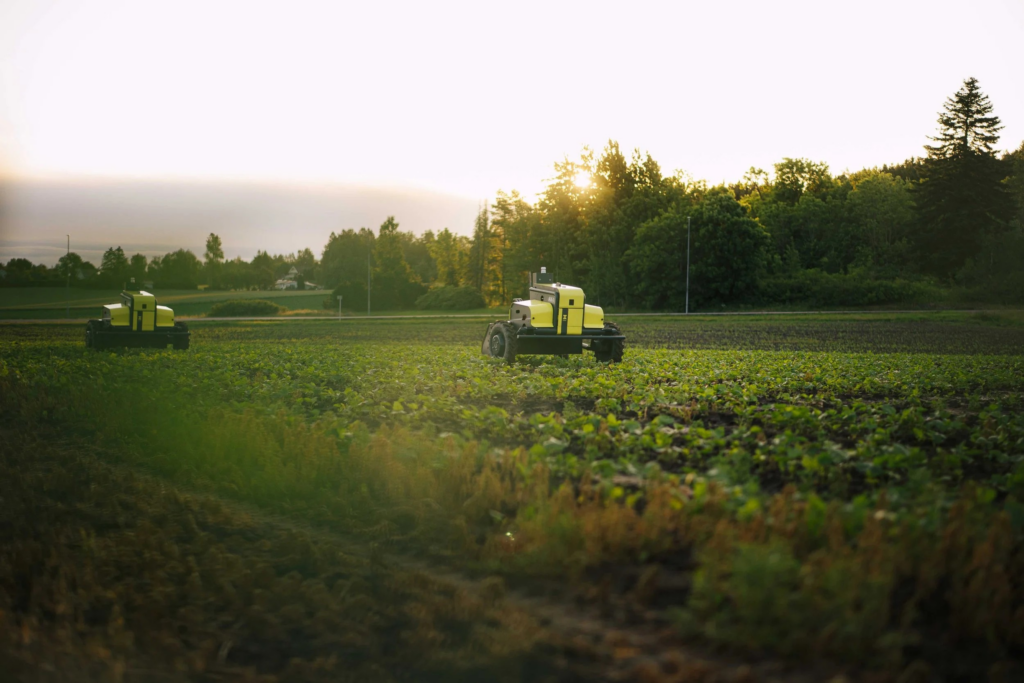
The headline claim—and the reason Kubota is paying attention—sits inside Kilter’s flagship robot, AX-1: it identifies weeds in bed-grown vegetables and applies micro-drops of herbicide with ~6 mm placement accuracy, targeting weeds individually and reducing herbicide use by “up to 95%.”
That number is attention-grabbing. The more interesting story is what it implies: the next “big” innovation in weed control may not be a new molecule at all—it may be moving selectivity out of chemistry and into computation.
The numbers that matter (and what they actually mean)
Kilter AX-1, per Kilter/Kubota:
- ~6 mm placement accuracy; weeds targeted in a 6×6 mm grid
- Applies micro-drops of pelargonic acid onto weeds
- “Typical weed pressure” cited at ~5%, translating into “up to 95%” herbicide reduction
- Designed to be low-weight; ~300 kg distributed dry weight (Kilter’s claim)
Now the key nuance: “Up to 95%” is basically weed-density math. If you only treat the pixels where weeds exist, the theoretical reduction roughly tracks the share of the field that’s actually weedy.
| Weed pressure (illustrative) | Area treated | Theoretical reduction vs broadcast |
| 5% | 5% | 95% |
| 10% | 10% | 90% |
| 25% | 25% | 75% |
So the promise isn’t magic. It’s something else: turning weed control into a measurement-and-targeting problem. And that’s exactly why a machinery giant like Kubota shows up—not just as a partner (announced Nov. 10, 2025) but now as a strategic investor.
Why Europe is the ideal pressure cooker for this approach
Kilter is building for a market with policy tailwinds and agronomic headwinds:
- Policy: the EU’s pesticide-reduction direction of travel is clear.
The European Commission set two non-legally binding targets announced in 2020: 50% reduction in the use and risk of chemical pesticides and 50% reduction in the use of more hazardous pesticides, measured against a 2015–2017 baseline.
Even “non-binding” targets create a kind of slow-motion gravity: retailers, processors, and grower organizations start planning around them. - Economics: vegetables are where labor costs hit hardest.
In an EU Parliament study on alternatives to crop protection, hand weeding is cited as ranging from €50 to €1,500 per hectare, depending on context.
That spread is the point: if you’re a vegetable grower, weeding can be an annoying line item—or a budget-eating monster. - Chemistry: specialty crops are a chronic “minor use” problem.
Most vegetables fall under Europe’s “minor crops/minor uses” umbrella: economically important for farmers, but often not economically attractive for pesticide firms because the authorization process requires extensive data. The European Minor Uses Coordination Facility estimates these crops are worth €60+ billion/year, about 20% of EU plant production value, yet can still face gaps in authorized products.
Translation: fewer tailored herbicide options, rising resistance pressures, and expensive approvals push growers toward anything that reduces reliance on broad chemical programs—without forcing them back into purely manual labor.
The “single drop” thesis: change the herbicide, or change the way you use it?
Kilter is explicit about the philosophy: “move selectivity from chemistry to software.”
That’s not just marketing. It’s an attempt to escape an uncomfortable corner:
- Mechanical weeding can be effective, but it’s often constrained by soil conditions and can risk damaging young crops/roots (Kubota’s own framing).
- Broadcast spraying is simple operationally, but it treats the field as if it’s uniformly weedy—even when it isn’t.
Kilter’s bet is that if you can “print” herbicide onto individual weeds (they’ve compared their droplet system to an inkjet printer), you can use micro-doses and potentially rely on different kinds of chemistries because the crop itself is largely avoided.
Kilter says AX-1 applies a micro droplet of pelargonic acid—a contact “burn-down” herbicide—onto weeds. Pelargonic acid is known for rapid, non-selective tissue burn-down and no soil activity (i.e., it acts on what it touches).
That pairing—contact herbicide + pixel targeting—is the core technical idea.
Why Kubota’s involvement is more than a logo on a press release
Kilter and Kubota already announced a Europe-focused partnership in November 2025, starting with dealer-supported rollout in Germany and the Netherlands, with pilot activity during the 2025 season (treatments from mid-April to September, several times per week depending on crop).
The funding turns that relationship into a strategic story:
- Distribution and service are existential for field robotics. Farmers don’t buy “AI.” They buy uptime, parts availability, and the confidence that someone will show up when something fails in peak season.
- If Kubota is investing, it’s signaling that it sees precision crop-care robotics as adjacent to its core business—something to sell, service, and bundle into a broader offering. (Kilter also frames Kubota’s value as industrial expertise, market insight, and global distribution support.)
This is what often separates ag robots that make headlines from ag robots that become a category: support infrastructure.
The competitive backdrop: targeted spraying is going mainstream—Kilter is pushing it into beds
Zoom out and you’ll see a pattern: the industry is converging on “spray less by seeing more.”
John Deere, for example, cites 66% herbicide savings for See & Spray (based on internal strip trials vs traditional application methods).
Kilter’s differentiation is the crop geometry and operating environment: bed-grown vegetables and other high-value crops where the cost of over-application (crop damage, residues, labor) is higher, and where conventional row-crop toolchains don’t always fit neatly.
In other words: Deere (and others) are making targeted spraying normal in broadacre contexts; Kilter is trying to make it operationally viable where weed control is most painful.
The uncomfortable question: does “less” automatically mean “safer”?
Not always—and this is where the conversation gets interesting.
Even when an active ingredient is “biobased” or perceived as benign, regulators still look at non-target risks and exposure pathways. In an EU Standing Committee summary from Oct. 2025, the Commission noted that renewing pelargonic acid as a low-risk active substance was not possible due to the need for specific measures to mitigate identified risks for non-target organisms; the discussion included whether it should be renewed as a regular active substance instead.
So the better framing for “single-drop” systems is not “chemical-free” but “exposure-engineered”:
- less volume applied overall (when weed pressure is low),
- less off-target contact with crop and soil (by design),
- but still dependent on the chemistry, context, and how regulators evaluate non-target impacts.
This matters because it forces a more honest thesis: precision isn’t a substitute for regulation; it’s a way to make compliance and performance less contradictory.
What Kilter is really selling (and what farmers should measure)
Kilter says it has been in commercial operation since 2021 and has customers across Northern Europe (including Norway, Sweden, Germany, and the Netherlands) using AX-1 in crops like carrots, onions, salads, and beets.
But the next phase—especially with Kubota involved—is likely to hinge on a few measurable outputs:
- Cost per hectare (all-in)
Not just chemical savings, but time, maintenance, supervision, and dealer service. - Weed-control efficacy over a season
Contact herbicides can be fast, but regrowth and missed weeds matter—especially when you’re treating at plant-level resolution. - Crop safety + quality outcomes
Kubota’s press release leans into quality, uniformity, earlier harvest potential, and residue concerns. - Robustness across real-world variability
Lighting, crop stage, wet leaves, soil splash, and “weird weeds” are where field AI earns or loses trust.
If Kilter can produce credible, third-party-backed performance data across these dimensions, the “95%” claim becomes less of a marketing number and more of a wedge into a durable category.
The bigger takeaway: the herbicide era isn’t ending—it’s being rewritten
There are two futures hiding inside this story:
- Future A: robotics helps agriculture use dramatically less chemistry, but still relies on chemistry as a tool—applied with surgical discipline.
- Future B: targeted application becomes so good (and so cheap) that the chemical business model shifts from selling volume to selling outcomes—“weed-free per hectare” rather than “liters per hectare.”
Kubota investing in Kilter suggests big OEMs want a seat at that transition, because if weed control becomes a software-and-service layer, the value moves toward whoever owns the platform farmers rely on during the season.
Kilter is trying to prove that in vegetables, one drop at a time.