In southern Idaho, an irrigation district installed four flow meters and discovered something awkward: a big gap between the water it thought it was delivering and the water it was actually pumping. The shortfall was about 35%—enough to turn a “nice-to-have” monitoring upgrade into a financial and political necessity. The metering work later fed into a wider modernisation effort, with an official estimate that 18,733 acre-feet a year—about 6.1bn gallons—could stay in the Snake River instead of leaking away through dirt ditches.
That story is becoming a template. Across irrigated agriculture, funding is shifting from building things you can point at—pipes, canals, pumps—to backing projects that can demonstrate measured, defensible outcomes. The new “product” being purchased is not concrete. It is verified water savings, backed by telemetry, sensors and, increasingly, software that can survive an audit.
This is not a small market. Agriculture accounts for roughly 70% of freshwater withdrawals worldwide, a statistic that turns “efficiency” into one of the few levers big enough to matter at scale. In the US, irrigation alone accounted for 118,000 million gallons per day in 2015—about 42% of total freshwater withdrawals.
When water is plentiful, the politics of measurement can be ignored. When it is scarce, measurement becomes the price of admission.
Why funders are asking for proof
Two forces are pushing public money toward outcomes-based logic.
First: the economics. A recent analysis of Colorado River projects illustrates why “new supply” is losing its shine. Researchers examined 462 federally funded conservation and supply projects totalling about $1bn (in 2023 dollars) over 2004–2024. They found agricultural conservation programmes saved water for as little as $69.89 per acre-foot, while new supply efforts—reservoirs, wells, wastewater treatment—cost more than $2,000 per acre-foot on average.
An acre-foot is a standard western US unit equal to 325,851 gallons.
When budgets are tight, those ratios change the conversation. The quickest path to “more water” is often paying for less use—but only if the savings are real, persistent, and not double-counted.
Second: the governance reality. Irrigation is no longer just an agronomy decision. It is increasingly a compliance problem—shaped by groundwater rules, endangered species constraints, drought plans, and water-rights enforcement. In that environment, “trust me” is not a funding model. What funders want is a baseline, a measurement method, and a post-project report that shows what changed.
The US federal signal: “quantifiable water savings”
The US Bureau of Reclamation’s WaterSMART Water and Energy Efficiency Grants (WEEG) programme is explicit about the new standard. Its funding opportunity is framed around projects that deliver quantifiable water savings and broader sustainability benefits. The programme also leans hard on co-investment: the FAQ states applicants must provide at least 50% of total project cost from non-federal sources, with award sizes ranging from up to $500,000 for smaller projects to up to $5m for larger, phased ones.
This is more than bureaucratic language. It creates a financial incentive to pick projects where savings can be measured and attributed—the water equivalent of energy efficiency’s “measurement and verification”.
And it changes what gets built. Look at the project descriptions funded under WEEG: the building blocks are flow meters, automation and data.
- In Nebraska, the Lower Republican Natural Resources District planned to install 1,800 irrigation flow meters with telemetry, plus weather stations, to help irrigators schedule water events more precisely. The project description estimates 8,790 acre-feet a year in water savings—about 2.86bn gallons—with added benefits in reduced pumping and energy demand.
- Another Nebraska effort aimed to install 200 flow meters and weather stations to improve forecasting and timing, with estimated annual savings of 207 acre-feet—about 67m gallons.
- A separate irrigation district modernisation project targeted 3,748 acre-feet of annual savings—about 1.22bn gallons—by upgrading diversion structures and improving delivery efficiency.
The common thread is not a particular device. It is the idea that savings must be instrumented.
USDA’s complementary approach: pay for “better management”, not just hardware
The Department of Agriculture is pushing in the same direction, though with a different toolkit.
NRCS’s WaterSMART Initiative is designed to complement Reclamation’s investments by using EQIP funding to help farmers and ranchers adopt practices and tools that improve water use efficiency—especially in targeted “priority areas”. NRCS describes this as providing resources to manage soil moisture and improve irrigation water use efficiency, among other benefits.
The priority-area page reads like a map of where the outcomes logic is being tested: it pairs big public goals (drought resilience, river flows, habitat protection) with practical interventions (metering, pipelines, soil moisture management). In the King Hill example in Idaho, the federal pages combine all of it: metering revealed losses; funding then helped replace leaky ditches; and the “outcome” is framed as conserved water remaining in the river system.
For AgTech, this matters because it places sensor-driven management—the messy, farm-level part—inside the funding story. The grant is no longer only for equipment. It is also for the capability to manage.
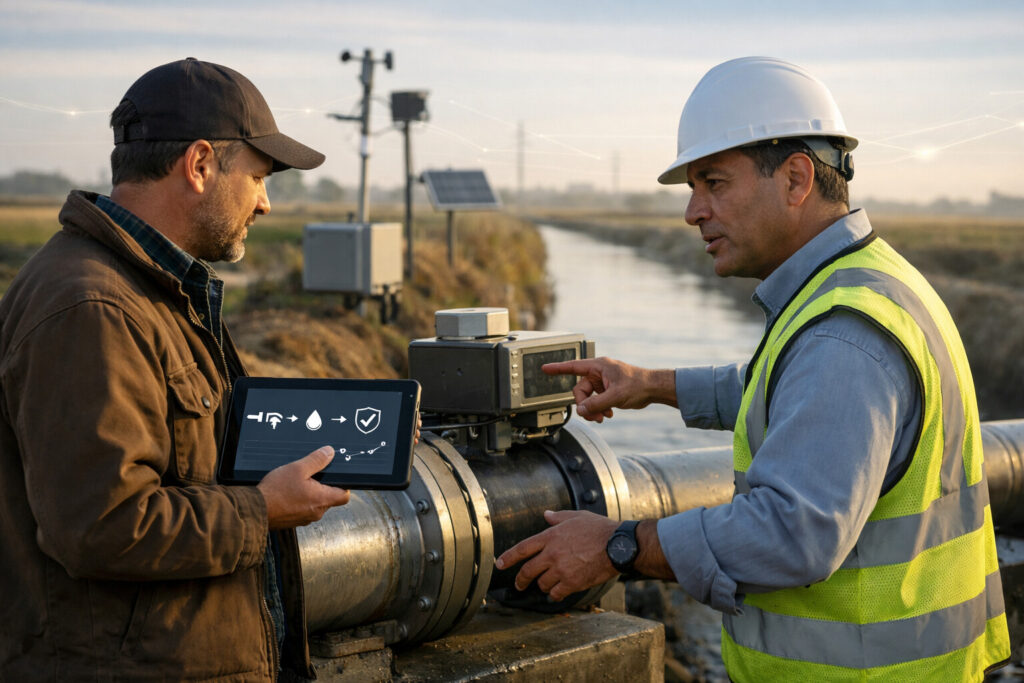
Telemetry turns water from a schedule into a system
So what does “telemetry + efficiency” actually mean on the ground?
At the simplest level, it means moving from assumptions to measurements:
- How much water was diverted at the headgate?
- How much reached the end of the canal?
- How much was pumped from the aquifer?
- When did the pump run, and for how long?
- Did the crop actually need the water at that moment?
Historically, many irrigation systems were designed to deliver reliability, not data. Water was allocated in turns, or via rough estimates, or through manual logs. That can work when there is slack in the system. It fails when every acre-foot is contested.
Telemetry changes the management posture. With remote meter reads, SCADA upgrades, and weather stations, managers can detect leaks, reduce over-delivery, and match supply more closely to demand. In theory, a district can also prove—rather than promise—that modernisation reduced diversions.
For funders, telemetry is a way to lower the risk that money buys activity rather than impact.
But measurement has politics—and farmers know it
There is a reason some growers feel uneasy about “smart water” funding. Data does not just illuminate inefficiency. It can also expose non-compliance.
If you are farming under a tightening groundwater cap, a flow meter can feel less like a tool and more like a future subpoena. If you are in a basin where water rights are contested, precise measurement can trigger disputes rather than resolve them. Telemetry invites oversight, and oversight can become enforcement.
This is where the outcomes model collides with trust. Public agencies want proof. Farmers want assurance that proof will not be used selectively against them.
The equity question is also real. Instrumentation is easiest for larger farms and well-resourced districts. Smaller operators face the classic adoption barriers: upfront costs, weak connectivity, maintenance, and the time burden of turning data into decisions. A funding system that requires sophisticated measurement can unintentionally favour those already equipped to comply.
The uncomfortable truth: efficiency does not automatically “save” water
There is also a deeper analytical problem: water savings are not always what they seem.
Researchers and water institutions have long warned about the “paradox of irrigation efficiency”. At the field level, switching from flood to drip can reduce applied water per hectare. But at basin scale, total consumption may not fall if the “saved” water is used to expand irrigated area, grow thirstier crops, or irrigate longer. The International Water Management Institute describes how efficiency gains at farm scale often fail to translate into basin-scale reductions in water consumption without governance and monitoring that protect and reallocate the freed water.
This paradox is one reason funders have become obsessed with measurement. It is not enough to pay for a more efficient nozzle. The relevant question is: did water actually remain in the river or aquifer—and did it stay there?
In other words, telemetry is not simply a tech trend. It is an attempt to solve an accounting problem that sits at the heart of water policy.
The budget wrinkle: accountability rises as money gets harder
Even within federal programmes, the supply of grant funding is not guaranteed. The Bureau of Reclamation’s FY2026 budget justification stated that no funding was requested for the WaterSMART programme in that year’s request, framing it as a shift toward maintaining existing assets.
Whatever happens in appropriations, the direction of travel is clear: when dollars are scarce, proof becomes a competitive advantage. Applicants who can quantify savings, show credible baselines, and report post-project outcomes will be better positioned than those selling generic “modernisation”.
What this means for AgTech
For AgTech companies, the story is not just “more sensors”. It is the emergence of a new buyer logic:
- Water agencies and funders are effectively purchasing a measurable outcome (saved water, reduced pumping, improved reliability).
- Farmers and districts are being asked to adopt a measurement stack (flow, weather, soil moisture, automation) as part of eligibility.
- Technology providers are selling not only hardware, but auditability: data quality, secure storage, clear methodologies, and reports that translate telemetry into defensible numbers.
The opportunity is large—but so is the responsibility. When public money is at stake, “AI irrigation” cannot be a black box. It has to be explainable to a grower, a water manager, and a regulator.
A thought to end on
For decades, water policy treated agriculture as a sector that needed better equipment. The emerging funding model treats it as something more complicated: a sector that needs a credible contract with society—a way to keep producing food while proving it is not quietly consuming the future.
Telemetry is becoming the language of that contract. It may also become the battleground.
Because once water is measured, the next question is unavoidable: who gets what, and who decides?