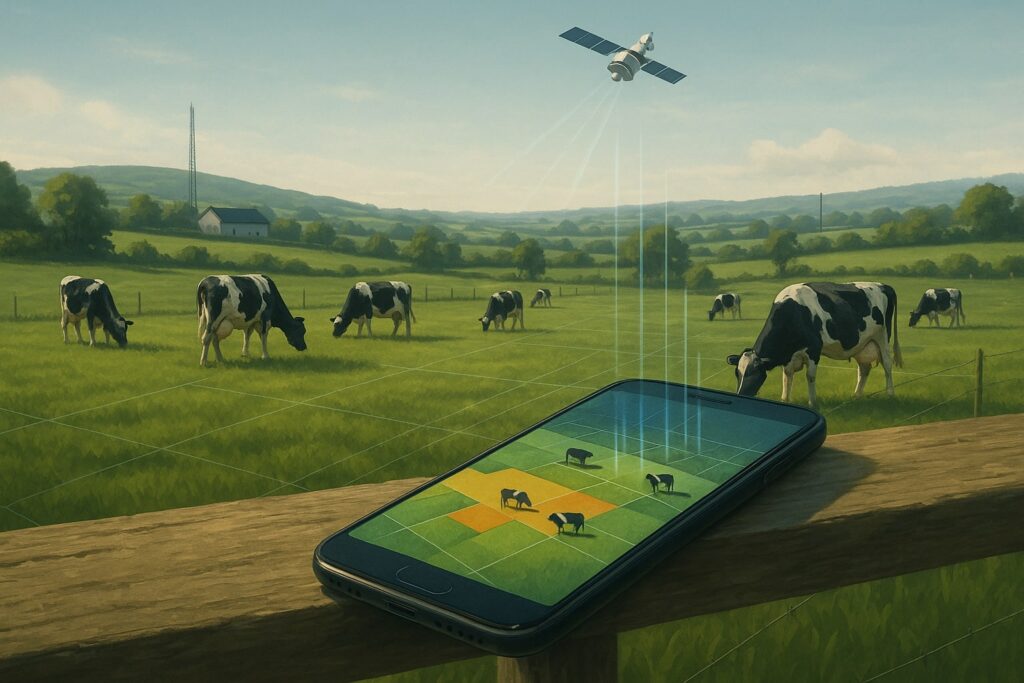
Ireland’s latest dairy innovation does not look like a new parlour or a shinier tractor. It looks like an app on a phone in a farmhouse kitchen in Munster — coloured paddocks on a map, numbers updating overnight, and a button that orders feed direct from the mill.
Behind that simple screen sits what is fast becoming an “AI dairy stack”: satellites scanning every field, machine-learning models predicting grass growth, a nutrition engine balancing rations, and a feed company that can see, almost in real time, what is happening on more than a thousand farms.
For an industry squeezed between volatile milk prices and tightening climate and water rules, this stack is not a gadget. It is starting to look like one of the few ways to keep Ireland’s pasture-based model intact.
Ireland’s grass advantage meets a regulatory squeeze
Ireland sells itself as a grass country, and the numbers support the story. Roughly 90% of the country’s agricultural land is in grassland, making grazed pasture the cheapest feed for both milk and meat.
By 2024 the country had around 1.5 million dairy cows producing some 8.3 billion litres of milk a year, much of it exported as butter, cheese and powders. The sector underpins rural incomes: dairy exports were worth about €6.8 billion in 2022, with around 17,000 dairy farmers averaging 91 cows per herd.
But the same grass-fed success story now sits at the centre of Ireland’s environmental headache. Agriculture accounts for 38.4% of national greenhouse-gas emissions, a far higher share than in most EU countries, and increased dairy cow numbers are a big part of that. Under the national climate plan, the sector must cut emissions 25% below 2018 levels by 2030 — a demanding target for a system built around methane-emitting ruminants.
Water quality is another fault line. Ireland has long benefited from a special derogation under the EU Nitrates Directive, which lets qualifying farms stock up to 250 kg of organic nitrogen per hectare, above the usual 170 kgN/ha cap. That derogation is being cut back to 220 kgN/ha in some areas and is due to expire in 2026; official modelling suggests that losing it entirely could force double-digit reductions in herd size and milk output, with the rural economy taking a hit measured in the high hundreds of millions to around €1.5 billion over a decade.
In short, Ireland’s comparative advantage — growing grass and turning it into milk — is now constrained by climate and water rules. That makes better grass management, and better documentation of that management, a strategic issue rather than a tidy efficiency gain.
The Proveye–MILJO–Howard Farms stack
Enter the new partnership that has put Ireland’s pastoral data into the cloud.
On 3 November 2025, Dublin-based agritech company Proveye and nutrition platform MILJO announced a commercial deal with Howard Farms, a leading feed and nutrition business in Munster. The aim: to bring an integrated AI-powered grassland and nutrition service to more than 1,000 dairy and beef farms, delivered through a single app.
The stack has three main layers:
- Satellites and AI models
Proveye specialises in remote sensing. Its platform ingests radar and multispectral imagery from European Space Agency Sentinel satellites, drone images, weather data, soil information and farm records. Machine-learning models then estimate grass cover, growth rates and sward composition for each paddock. - Pasture and nutrition app
MILJO runs a modular nutrition and feed-order system that builds rations around each herd’s performance targets. Under the partnership, the app now pulls in Proveye’s per-paddock measurements and growth forecasts, so grass supply and feed demand sit in the same interface. Farmers can see how much grass is available, how fast it is growing, what that means for grazing rotations — and, crucially, how much concentrate they actually need to buy. - Feed-mill and on-farm advisory network
Howard Farms, based in Cork, manufactures livestock feed and has long-standing relationships with producers across Munster. Its sales and advisory staff become the human face of the digital system, helping farmers interpret the data and adjust grazing plans, while the app links directly to feed orders and delivery schedules.
For farmers, the promise is simple: one tool instead of three different spreadsheets and a flurry of phone calls. According to the partners, users should be able to:
- get daily grass measurements and growth forecasts for every paddock;
- plan grazing to maximise grass utilisation;
- align concentrate purchases with actual need; and
- link nutritional plans to real-time milk or beef performance data.
It is a modest-looking interface for what is, in practice, a sophisticated data pipeline from space to stomach.
From platemeters to pixels: Ireland’s digital pasture ecosystem
The Proveye–MILJO stack does not emerge in a vacuum. Over the past decade Ireland has been quietly building one of the world’s most advanced national grassland databases.
Teagasc, the state agriculture and food agency, runs PastureBase Ireland, a web-based decision support tool and centralised database that tracks grassland performance at paddock level. Farmers use a handheld or rising plate meter to measure sward height, then enter readings into the system via an app. PastureBase calculates pre-grazing herbage mass, farm cover per hectare, weekly growth and feed budgets; it also hosts tools for nitrogen-use efficiency and mapping.
Research shows that PastureBase’s models can estimate annual dry-matter yield with a relative prediction error of around 15%, a level of accuracy considered acceptable for management decisions. Users tend to grow and utilise more grass than the national average, reinforcing the view that better measurement leads to better performance.
Alongside PastureBase, Irish researchers and advisors have experimented with technologies such as:
- Grasshopper, a GPS-enabled grass-measurement tool that sends biomass readings straight to a smartphone app;
- cow-wearable sensors for heat detection and behaviour; and
- early trials of virtual fencing, which use audio and mild electrical cues instead of physical wire.
Proveye’s offer is to lift some of the measurement burden off farmers’ shoulders. Instead of physically walking every paddock weekly with a platemeter, a farmer can let the satellites do most of the counting, using occasional manual checks for calibration. For busy herds operating with tight labour, this matters.
The system also adds a historical and spatial dimension that handheld tools struggle to match. By analysing years of imagery, Proveye’s models can distinguish consistently under-performing paddocks, areas prone to waterlogging, or fields that respond poorly to fertiliser.
Where PastureBase built Ireland’s grass data exhaust, Proveye aims to turn it into prescriptive intelligence.
Satellites meet Brussels: fertiliser maps and nitrates quotas
The next layer in the stack is fertiliser. Nitrogen is both a cornerstone of grass growth and a central target of EU regulation.
In November 2025, Proveye secured a contract from the European Space Agency to accelerate ProvVari, a satellite-based precision fertiliser platform built on its existing grass-monitoring system. The company estimates that ProvVari could cut nitrogen fertiliser use by up to 30% a year without reducing grass growth, by shifting from blanket spreading to per-paddock variable-rate application.
In climate terms, Proveye suggests that each kilogram of nitrogen avoided could prevent around 4.16 kg of CO₂-equivalent emissions, once fertiliser production and field nitrous oxide are counted.
For an Irish dairy farm operating under a nitrates quota, the logic is easy to grasp:
- Use satellites and PastureBase to quantify grass demand.
- Use ProvVari to apply fertiliser only where it will pay back.
- Use MILJO to match the resulting grass growth with the herd’s feed needs.
- Use the same data trail to demonstrate compliance to regulators and to processors demanding sustainability metrics.
Teagasc’s own modelling under the Nitrates Derogation scenarios highlights strategies like reduced fertiliser rates, better nitrogen use efficiency and improved grass utilisation as key to staying within stocking-rate limits without simply culling cows.
In this context, Proveye is not just selling yield. It is selling regulatory room to manoeuvre.
Will the numbers add up on farm?
The appeal for policymakers and advisers is obvious: more data, more control, better optics in Brussels. For farmers, the calculus is more granular.
On the savings side:
- If ProvVari’s 30% fertiliser reduction proves robust, the drop in nitrogen purchases could be substantial, especially as fertiliser remains one of the most volatile input costs.
- PastureBase statistics show that farmers who manage grass actively tend to grow more pasture and rely less on bought-in feed.
- MILJO’s pitch is that better alignment between grass supply and concentrate use should maximise the value of purchased feed, improving margins per litre.
On the cost side:
- None of the companies publish a detailed price list, but any subscription-based service plus occasional advisory visits and hardware inevitably adds to cash outflows.
- The return will vary with farm size, existing management and the quality of execution — a highly disciplined operator using PastureBase already may see less incremental gain than a farm that previously grazed by rule of thumb.
Ireland’s experience with earlier technologies offers some hints. Tools like Grasshopper and cow-wearable sensors have been adopted by a “small but growing” minority of farmers; they are particularly attractive where labour is tight and herds are expanding.
Meanwhile, average debt per Irish farmer with borrowings is over €117,000, according to ACCA analysis, leaving limited room for expensive experiments that do not pay back quickly.
The danger is that the AI stack becomes yet another technology that large, well-capitalised farms adopt early, widening the performance gap with smaller neighbours.
Who owns the pasture data?
There is also the quieter question of data power.
The new service pulls information from multiple sources: satellites, weather stations, farm management systems, milk processors, feed mills and the farmer’s own inputs. Over time, it will build a detailed profile of each paddock and herd — how they respond to weather, fertiliser, stocking rate and feed.
Some of that data is clearly valuable:
- For farmers, it informs management and may support access to sustainability bonuses or carbon credits.
- For feed mills and advisors, it improves targeting of products and services.
- For processors and retailers, it helps quantify the carbon footprint and water impact of their supply chains.
- For regulators, it offers evidence on whether fertiliser and stocking rules are working.
Ireland already has one large-scale template for this in Origin Green, Bord Bia’s national sustainability programme, which audits virtually all dairy farms and uses the results to underpin green branding abroad.
As more of the measurement shifts from clipboards to proprietary algorithms, the balance of bargaining power could shift as well. A farmer might own the land and the cows — but who owns the insights about that land and those cows once they are processed by AI?
Contracts and governance arrangements will matter. Clear rules on data access, portability and anonymisation will be needed if farmers are to trust the stack they are being asked to plug into.
A template for pasture economies beyond Ireland?
Seen from Brussels or Wellington, the Irish experiment is more than a local curiosity. It is an early example of a fully digital grassland system, combining:
- a national decision-support and data platform (PastureBase);
- commercial AI layers for biomass and fertiliser (ProvGrass and ProvVari);
- farm-level apps for nutrition and ordering (MILJO); and
- a network of advisors and feed mills who act as the connective tissue.
Proveye plans to launch ProvVari in Ireland in early 2026, then expand into mainland Europe and New Zealand. Similar “farm operating systems” are emerging in other sectors, from AI-driven platforms for palm-oil plantations in Malaysia to digital twins for orchards and vineyards.
Ireland’s advantage is that it starts from a concentrated, grass-based dairy sector with relatively sophisticated advisory services and a strong policy push to cut emissions. If satellites, sensors and cows can be knitted together anywhere, it is here.
But digital tools will not decide the future alone. The core political questions remain: how much livestock Ireland wants, what environmental standards it is prepared to enforce, and how the costs of transition are shared between taxpayers, consumers and farmers.
The AI dairy stack can help answer “how” questions — how to grow more grass with less nitrogen, how to validate claims about low carbon footprints, how to time grazing rotations. It cannot answer “how much” questions on its own.
For now, though, the direction of travel is clear. In the Munster kitchens where farmers swipe through paddock maps over breakfast, the pasture has already gone digital. The rest of the dairy system — from regulators in Dublin to buyers in Shanghai — is starting to adjust to the idea that the humble green field is becoming a data asset as much as a physical one.
Whether that shift ultimately protects Ireland’s grass-based advantage or simply measures its contraction will depend on choices made far from the paddock. But one thing is obvious: in the next phase of the country’s dairy story, the most important piece of machinery may be the one in the farmer’s pocket.