The USDA’s new National Proving Grounds Network for AgTech is supposed to test digital and AI-driven tools under real U.S. farm conditions. The bigger story is not the announcement itself. It is whether public validation can finally fix one of agriculture’s oldest innovation problems: too many promising tools, and too little trusted evidence about what actually works in the field.
For years, agtech has suffered from a familiar pattern. A startup unveils a promising robot, sensor, data platform, or machine-vision tool. Growers see the demo. Investors hear the pitch. Conference panels fill up. But when the moment of actual farm adoption arrives, the questions turn harder, and far more practical. Does it work outside a polished pilot? Does it work on my crop, in my soil, under my labor conditions, with my margins? Does it save enough money, or make enough money, to justify the risk? That is the context in which the USDA, on April 7, launched the National Proving Grounds Network for AgTech, or NPG-Ag, a nationwide effort led by the Agricultural Research Service, with Grand Farm as national program manager and land-grant universities serving as core research and testing partners. The stated aim is straightforward: rigorously test agricultural technologies under real-world production conditions and give farmers trusted performance and economic-return data for investment decisions.
That may sound like a bureaucratic exercise. It is not. In fact, it may be one of the more consequential agtech moves the federal government has made in years. The United States does not lack agricultural innovation. What it often lacks is a widely trusted way to separate technologies that are interesting from technologies that are investable. USDA’s new network is essentially a bet that the missing infrastructure in agtech is not only more invention. It is better proof. USDA’s own framing makes that clear: the network is meant to help producers lower input costs, reduce labor demands, improve efficiency, cut risk, and access data they can actually use when deciding whether to buy into a new tool or pass.
The bottleneck is not hype. It is adoption.
That distinction matters because agtech adoption in the United States remains far more uneven than the public narrative often suggests. According to the Government Accountability Office, only 27 percent of U.S. farms or ranches used precision agriculture practices to manage crops or livestock based on 2023 USDA reporting. USDA’s Economic Research Service shows a similarly mixed picture beneath the surface. Automated guidance systems have spread widely and are used on well over half of acreage planted to corn, cotton, rice, sorghum, soybeans, and winter wheat. But other digital tools have penetrated much less deeply. USDA says technologies such as yield maps, soil maps, and variable-rate technology have been adopted on only 5 percent to 25 percent of total planted acreage for crops such as winter wheat, cotton, sorghum, and rice. Aerial imagery, despite years of buzz, has remained limited too, reaching 7.0 percent of corn acreage in 2016 and 9.8 percent of soybean acreage in 2018, with lower levels for winter wheat, cotton, and sorghum.
That adoption pattern tells an important story. Farmers are not rejecting technology in the abstract. They are selectively adopting the tools that deliver obvious operational value and fit existing workflows, while moving far more cautiously on tools that are harder to validate, harder to integrate, or harder to justify financially. In that sense, the most important barrier in agtech is not always awareness. It is confidence. The economics of the farm sector help explain why. USDA’s Economic Research Service said in its latest review that 85 percent of farm households received more than half their income from off-farm sources, and 51 percent had negative income from farming. That does not mean American agriculture is weak. It means many producers cannot treat new technology as a speculative experiment. Every capital outlay has to survive contact with volatile margins, labor constraints, weather shocks, and debt costs.
Seen from that angle, NPG-Ag looks less like a flashy innovation initiative and more like an attempt to solve a capital-allocation problem. The farmer deciding whether to spend on a precision sprayer, a weed-recognition system, a sensing platform, or an automation tool is not really buying “innovation.” The farmer is buying a probability distribution of outcomes. USDA is trying to narrow that uncertainty.
What USDA is actually building
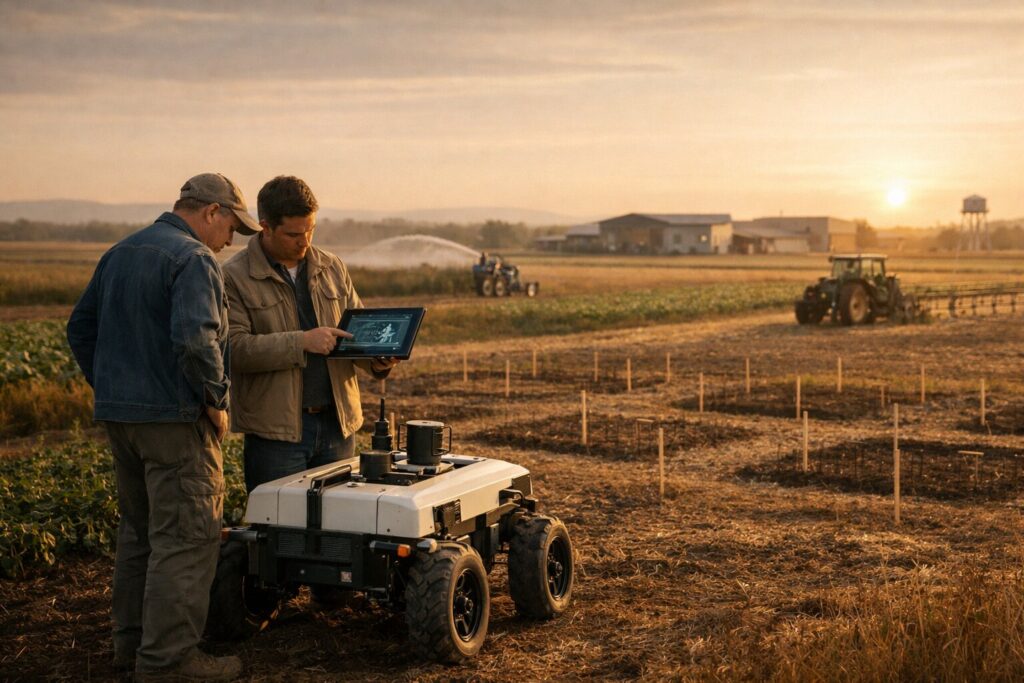
The design of the network is more serious than a standard pilot-and-press-release cycle. USDA says the proving grounds will use a structured process that includes technology intake, readiness review, standardized field testing, and performance evaluation. Results are expected to reach producers through dashboards, field days, and demonstration events rather than remaining buried inside a research file or a vendor deck. Companies with commercial and pre-commercial products can participate, and pre-commercial tools may be tested under non-disclosure terms while developers work with research partners to refine performance before wider release. USDA says it will provide the testing and certify the results, while Grand Farm will handle much of the logistics and serve as the focal point for company engagement; nominal entry fees may be used to offset testing, analysis, and reporting costs.
The initial focus is also telling. USDA says the early phase will concentrate on weeds, combining traditional visual ratings with computer vision and machine learning to measure weed density and coverage before and after precision technologies are applied. Later phases are intended to expand into disease, animal production, and water management. That progression makes sense. Weed control sits at the intersection of input costs, chemical resistance, labor scarcity, automation, and AI-based field intelligence. In other words, it is a near-perfect proving ground for the claim that digital agriculture can deliver measurable economic value, not just better-looking dashboards.
The basic logic also lines up with what federal analysts have been saying for some time. The GAO concluded last year that precision agriculture can improve profitability and environmental outcomes, but that broader adoption is held back by high up-front costs, complexity, and uncertainty. Its policy options included better benefit-cost tools, more on-field demonstrations, and stronger extension-style support so farmers could judge technologies using real-world evidence rather than abstract promises. The same report noted that USDA and NSF had already provided nearly $200 million in precision-agriculture research and development funding between fiscal years 2017 and 2021. The problem, then, is not simply a lack of R&D. It is the long and messy translation of R&D into confident farm use.
Why this matters more in a tougher funding market
The timing is not accidental. Agtech is maturing in a colder financial climate than the one many startups grew up in. AgFunder’s 2025 global report found that agrifoodtech funding in 2024 totaled $16 billion, down 4 percent year over year, while upstream investment fell 22 percent. In plain English, capital is no longer as patient with long timelines, vague commercial pathways, or “trust us” product claims. That changes the value of validation infrastructure. In a tighter market, independently generated evidence on performance and return on investment becomes more than a technical nice-to-have. It becomes commercial ammunition. It can help investors identify which companies deserve another round, help strategic buyers identify tools worth integrating, and help farmers distinguish between genuine productivity tools and software theater.
USDA also did not choose an empty shell to run the national program. Grand Farm says it already operates within a network of more than 3,300 organizations, has conducted more than 80 field trials, and counts 91 annual partners across its ecosystem. That gives the proving-grounds initiative an existing operational base and a convening structure that many federal programs spend years trying to assemble. But this is where the scrutiny should intensify, not soften. An innovation ecosystem is not the same thing as a neutral evidence platform. The real test is whether NPG-Ag behaves like a public benchmarking system, with standardized methods and credible comparability, rather than a sophisticated channel for vendor validation. USDA’s claim that it will certify results while Grand Farm handles logistics is important precisely because that line will need to hold.
What the network still cannot solve on its own
Even if NPG-Ag works exactly as designed, it will not erase the structural frictions that have slowed precision agriculture for years. The GAO highlights several of them: high acquisition costs, farm-data ownership and sharing concerns, and a lack of common standards that can make interoperability difficult across platforms and equipment. Those are not minor issues. A tool can perform well in a trial and still fail in the market if it does not integrate with existing machinery, creates new data headaches, or produces payback only at a scale that excludes much of the farm sector.
That last point matters more than agtech rhetoric often admits. USDA’s latest farm-structure data show that family farms remain the dominant type of U.S. farm, accounting for 96 percent of all farms and 83 percent of production, while 86 percent of U.S. farms are small family farms that operate 41 percent of agricultural land but account for 17 percent of production. That is not a niche detail. It means the addressable market for any agricultural technology is not one uniform buyer with one uniform balance sheet. It is a layered landscape of different scales, production systems, labor realities, and tolerance for payback periods. A national proving-grounds network will be most useful if it produces not just a generic verdict that a technology “works,” but a more granular answer about where, for whom, and under what cost structure it works.
That is why the most valuable output from NPG-Ag may not be a list of successful technologies. It may be a clearer map of conditional success. Which tools make sense for large row-crop operators? Which are better suited to specialty crops where labor pressure is more acute? Which products create measurable input savings, and which depend on assumptions that fall apart outside carefully managed test environments? Which technologies deliver operational simplicity, and which impose a data-management burden that only the most sophisticated operators can absorb? A proving-grounds model is powerful precisely because it can answer those uncomfortable questions before a farm business learns the answer the expensive way.
The credibility test will be simple
USDA has outlined the bones of the model, but not every operating detail. The department says farmers will receive results through dashboards, field days, and demonstration events, but specific producer-facing mechanisms are still being developed. Extension specialists from land-grant universities are expected to participate, and USDA says NIFA is exploring ways to connect the network to existing funding programs in the FY2027 cycle. That suggests the proving grounds could become more than a one-season pilot if the structure holds and Congress or the department keeps backing it.
But the credibility test itself is simple. Will USDA publish results that are merely positive, or results that are actually useful? Farmers do not just need success stories. They need failed trials, middling payback, crop-specific limitations, region-specific caveats, and honest evidence about when a technology is not ready. The more the network behaves like a public evidence layer for agricultural technology, the more transformative it could become. The more it behaves like a certification halo for participating vendors, the less it will matter.
That, ultimately, is what makes the National Proving Grounds Network for AgTech worth watching. American agriculture is not short of people building things. It is not short of software, sensors, autonomy concepts, AI claims, or conference-stage optimism. What it has been short of is shared, trusted, decision-grade evidence. If USDA can build that layer successfully, it will have done something more valuable than funding one more innovation cycle. It will have improved the conditions under which real adoption happens. In agtech, that may be the harder problem, and the more important one.