A 43% yield increase is the kind of number that makes agronomists squint.
That’s exactly what a recent field demonstration in Vietnam is claiming for a foliar-applied biostimulant derived from agricultural residues: treated rice plots produced 688.7 kg per 10 ares (0.1 ha) versus 482.8 kg per 10 ares in untreated plots—an uplift of 205.9 kg per 10 ares, or ~43%.
Translated into the units farmers, lenders, and policymakers care about, that’s roughly 6.89 t/ha vs 4.83 t/ha—an incremental ~2.06 t/ha—and an estimated profit increase of ~VND 40.2 million per hectare under the trial’s conditions. The study also claims the economic return was more than six times the cost of applying the biostimulant.
If that holds up outside a demonstration plot, it’s not just “nice yield.” It’s a potential reshuffle of the rice input stack—one that ties climate resilience, fertilizer efficiency, and circular economy messaging into a single product.
But first: what actually happened in the field—and what do we still need to know before anyone starts treating “43%” as a forecast?
The trial, in plain numbers
According to reporting on the project, the demonstration ran for about five months in Hung Yen Province (a northern rice-growing region) during a production window from June to October 2025.
The partners: Japan’s Mitsubishi Research Institute (MRI), Vietnam’s PAN Group (parent of seed company Vinaseed), and Agri Smile, a Japan-based agtech company focused on biostimulant materials.
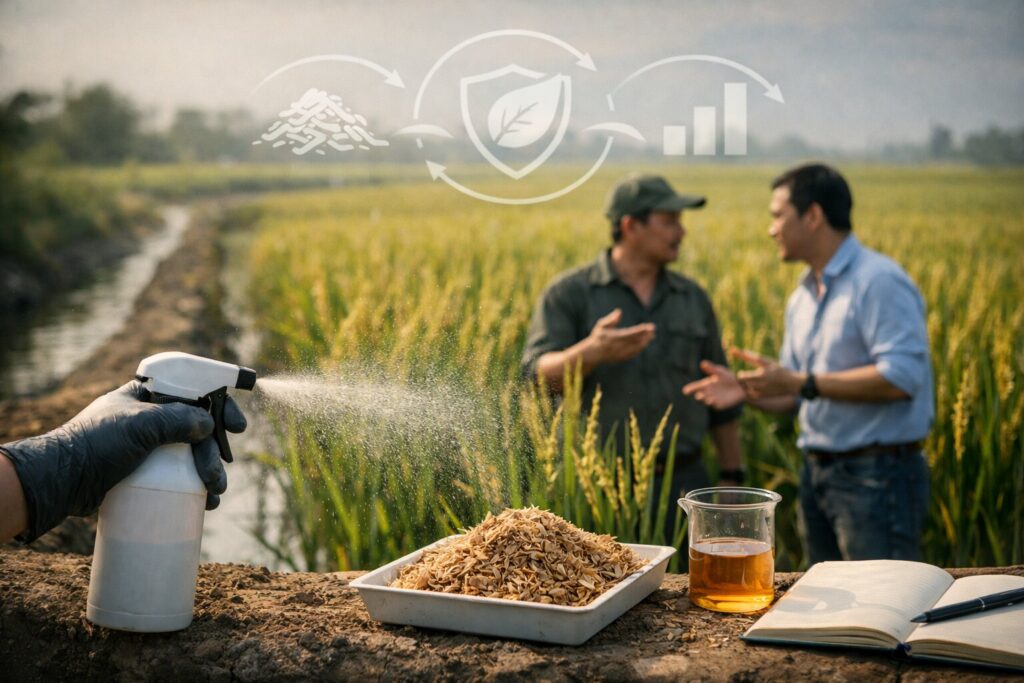
The pitch: the biostimulant is derived from agricultural residues, designed to enhance plant immunity and nutrient uptake, and the demo explicitly targeted high-temperature tolerance, root development, and lower-fertilizer production while maintaining yield and quality.
The headline metrics reported:
- Yield (treated): 688.7 kg per 0.1 ha
- Yield (control): 482.8 kg per 0.1 ha
- Uplift: +205.9 kg per 0.1 ha (~43%)
- Profit impact: ~VND 40.2m/ha (estimated)
- Return: >6× the application cost (trial conditions)
The usual caveat appears too: results may vary with agronomy and environment.
Why rice—and why Vietnam—makes this more than a one-off
Vietnam is not a niche test market. FAO’s GIEWS country brief (reference date February 26, 2026) puts Vietnam’s 2025 paddy production at ~43.5 million tonnes, and forecasts ~7.9 million tonnes of rice exports in calendar 2026.
The U.S. Department of Agriculture’s Foreign Agricultural Service (FAS) puts Vietnam’s average yield around ~6.10–6.16 t/ha across recent marketing-year estimates/forecasts—right in the neighborhood of what the treated plot achieved in this demo.
That matters, because the most interesting part of the Vietnam demo isn’t just “we hit 6.9 t/ha.” It’s that the control plot was notably below that ~6 t/ha national average band. In other words, this might be a story about recovering yield lost to stress as much as it is about pushing the frontier.
That interpretation is consistent with the demo’s stated focus: tropical/subtropical conditions, heat tolerance, and nutrient uptake efficiency.
The hidden villain in the rice P&L: fertilizer
The economic context here is not subtle: fertilizer is expensive, volatile, and often overused.
IRRI—working with Vietnam’s ministry and the U.S. Department of Agriculture (USDA) via the Fertilize Right project—cites a 2023 survey of 10,000 farmers in the Mekong Delta finding fertilizer costs are ~30% of the cost of producing rice, with “traditional” practices including >110 kg of nitrogen per hectare and seed rates >120 kg/ha.
In parallel, FAO notes Vietnam’s domestic wholesale rice prices in January 2026 were 10–30% lower year-on-year across the country—exactly the kind of price pressure that makes farmers more sensitive to input efficiency.
Put those together and you get a simple incentive equation:
- If rice prices are flat-to-down, yield resilience matters more than ever.
- If fertilizer is a third of costs (and often applied inefficiently), nutrient-use efficiency is low-hanging margin.
- If climate volatility is amplifying heat and water stress, farmers pay for solutions that reduce “bad luck” variance—not just average yield.
Which is basically the biostimulant pitch in one paragraph.
The “waste-to-yield” twist: circular inputs as a product category
Biostimulants have been marketed for years as “make plants handle stress better.” What’s newer is the circular supply chain storyline: turning local waste streams into higher-value agricultural inputs.
Agri Smile describes its approach as converting local food waste into biostimulants—creating “food from food”—with claims around reduced chemical fertilizer dependence and improved climate resilience.
In the Vietnam project reporting, the material is described as derived from agricultural residues, with the Vietnamese coverage adding that the inputs were developed from Japan-origin agricultural by-products.
This is more than branding. If the feedstock is low-cost and abundant, it changes the unit economics:
- You can price competitively versus conventional crop inputs.
- You can build local manufacturing or regional processing moats.
- You can sell to policymakers and buyers as “low-carbon agriculture,” not just “a spray.”
And the timing is right: industry estimates put the global biostimulants market in the low single-digit billions with high-single to low-double-digit growth (depending on the source). EBIC (the European Biostimulants Industry Council) cites ~10–12% CAGR as a commonly reported range, while Grand View Research estimates a ~$3.17B market size in 2025.
The part that should make you cautious: what isn’t disclosed (yet)
A 43% lift is not impossible. But it is unusual—and that makes trial design details non-negotiable.
To assess whether this is a real agronomic signal (vs. a perfect-storm demo), readers will want answers to questions like:
- Replication & statistics
How many plots? How many replications? Was the difference statistically significant? - Baseline agronomy
Were both plots managed identically—same variety, planting date, pest control, irrigation schedule, and fertilizer rates? - What changed—yield components or harvest conditions?
Was the uplift driven by more tillers, heavier panicles, better grain filling under heat, or lower losses? - Fertilizer reduction—measured or intended?
The project framing emphasizes “low-fertilizer production” and “improved uptake efficiency,” but the public reporting doesn’t spell out whether fertilizer rates were actually reduced in the treated plot (and by how much). - Mechanism (enough to trust, not a thesis)
“Enhanced immunity” can mean many things. Farmers don’t need molecular biology, but they do need repeatability: what conditions does it work best under—and when should you skip it?
The partners themselves acknowledge variability by environment and agronomic conditions.
This is why serious biologicals companies increasingly win not by “one big number,” but by building a playbook: where it works, where it doesn’t, and how to stack it with other practices (seed choice, nutrient timing, irrigation strategy).
A quick reality-check on the economics
The demo reports an estimated VND 40.2m/ha profit increase.
At roughly ~26,200 VND per USD (as of March 2, 2026, per Trading Economics), that’s about ~$1,500/ha.
That’s meaningful in rice economics—especially for commercial farms and co-ops—but it also raises a fair question: what assumptions are baked into “profit”?
Is this net of labor? Based on a specific paddy price? Does it include any quality premium? Does it assume a certain application cost and equipment availability?
Those details don’t invalidate the result. They simply determine whether the “6× ROI” is broadly portable—or context-specific.
The bigger signal: Vietnam is building the rails for biologicals
This isn’t a random startup dropping a product into a market and hoping for distributor magic. PAN Group and its partners have been signaling for months that biostimulants could become a strategic growth area—especially as Vietnam pushes organic/biological agriculture and export standards.
Their September 2025 cooperation agreement explicitly framed the relationship as a pathway from field trials to registration and distribution in Vietnam.
Zoom out further and you see a pattern: Vietnam’s rice system is under pressure to deliver more (stable supply, better quality, lower emissions) with less (fertilizer, chemicals, water, emissions headroom). That’s exactly the environment where “plant physiology products” become mainstream—if they’re consistent and priced right.
The IE take: “waste-to-yield” could be real—if it survives contact with average farms
It’s easy to fall in love with a big number. The more interesting story is what the number implies:
- If residue-based biostimulants can reliably boost stress tolerance and nutrient-use efficiency, then the next productivity leap may come less from new fertilizer chemistry—and more from how plants use what we already apply.
- If that input is manufactured from agricultural by-products, the “sustainable” claim becomes structural, not marketing.
- And if it can be operationalized (repeatable protocols, predictable ROI bands), it becomes financeable: co-ops, insurers, and lenders can underwrite it.
But the burden of proof is higher now. A 43% demo result doesn’t end the debate; it starts it.
The next milestones to watch are boring—but decisive:
- multi-season, multi-location trials
- disclosed fertilizer-rate scenarios (what happens at -10%, -20%, -30% nitrogen?)
- third-party verification
- adoption evidence: not a pilot, but paid re-orders
Because in rice, the only metric that really matters is the one farmers repeat with their own money.